


Page 13 - Azerbaijan State University of Economics
P. 13
Yadulla Hasanli, Nazim Hajiyev, Gunay Rahimli:Distribution and Analysis of Admission
                                                                                                              Scores (In the Case of Azerbaijan

                    As can be seen χ 2        =391.7. As the number of intervals k=10, the number of

                    parameters of the distribution s=2,  the value of the degree of freedom r=k-1-s=7. At
                    this price of the degree of freedom, χ2(0,05;7)=14.07-dir. Thus, because inequality
                    of χ 2       < χ2-critic is not true in this case, we reject the hypothesis that scores

                    distributied normally.

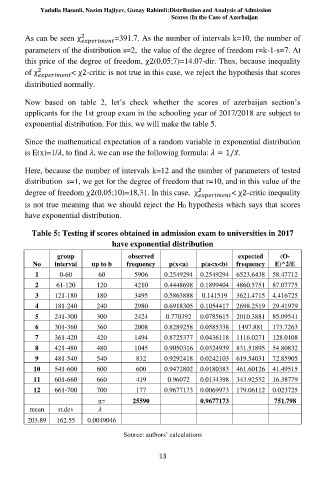
                    Now  based  on  table  2,  let’s  check  whether  the  scores  of  azerbaijan  section’s
                    applicants for the 1st group exam in the schooling year of 2017/2018 are subject to
                    exponential distribution. For this, we will make the table 5.

                    Since the mathematical expectation of a random variable in exponential distribution
                    is E(x)=1/  , to find   , we can use the following formula:    = 1/  ̅.

                    Here, because the number of intervals k=12 and the number of parameters of tested
                    distribution  s=1, we get for the degree of freedom that r=10, and in this value of the

                    degree of freedom χ2(0,05;10)=18,31. In this case,  χ 2      < χ2-critic inequality

                    is not true meaning that we should reject the H0 hypothesis which says that scores
                    have exponential distribution.

                      Table 5: Testing if scores obtained in admission exam to universities in 2017
                                              have exponential distribution
                             group                observed                         expected    (O-
                      No     interval   up to b   frequency   p(x<a)    p(a<x<b)   frequency   E)^2/E
                       1      0-60       60         5906     0.2549294  0.2549294  6523.6438  58.47712
                       2     61-120      120        4210     0.4448698  0.1899404  4860.5751  87.07775
                       3     121-180     180        3495     0.5863888   0.141519   3621.4715  4.416725
                       4     181-240     240        2980     0.6918305  0.1054417  2698.2519  29.41979
                       5     241-300     300        2424     0.770392   0.0785615  2010.3881  85.09541
                       6     301-360     360        2008     0.8289258  0.0585338   1497.881   173.7263
                       7     361-420     420        1494     0.8725377  0.0436118  1116.0271  128.0108
                       8     421-480     480        1045     0.9050316  0.0324939  831.51895  54.80832
                       9     481-540     540         832     0.9292418  0.0242103  619.54031  72.85905
                      10     541-600     600         600     0.9472802  0.0180383  461.60126  41.49515
                      11     601-660     660         419      0.96072   0.0134398  343.92552  16.38779
                      12     661-700     700         177     0.9677173  0.0069973  179.06112  0.023725
                                         n=         25590               0.9677173             751.798
                     mean    st.dev
                     203.89   162.55   0.0049046

                                                 Source: authors’ calculations

                                                           13

