


Page 11 - Azerbaijan State University of Economics
P. 11
Salah Salimian,  Mahdi Movahedi Beknazar, Kiumars Shahbazi, Zahra Khalilzadeh Silabi: The Role
                       of Investment in the Equilibrium of International Political Economy (Game Theory Approach)

                    METHODOLOGY
                    The research methodology will be presented here in three subsections:

                    Game theory
                    The  modeling  of  game  theory  in  international  economy,  work  economy,  major
                    economy and general tax becomes general and is now moving towards development
                    economy and economic history. Many of those who make models utilize game theory
                    as it allows them to think as an economist when the pricing theory is not sufficient
                    and responding (Gibbons, 1997). The present study has used game theory to achieve
                    the research objectives.

                    Game theory tries to model the situations where individuals' interests are in conflict. The
                    main aim of game theory is to present an attitude and approach based on which the players
                    can wisely behave and before taking any action, think deeply about it and select the action
                    which is to their benefit. Game theory is especially useful when the number of competing
                    players  (agents)  is  limited  since  in  this  case;  any  player  significantly  influences  the
                    earnings of other players (Abduli, 2012; Mas-Colell et al. 1995).

                    Games have various dimensions; therefore, various classifications could be presented.
                    The main classification is  to  classify games into cooperative and non-cooperative
                    games. The game theorists differentiate the non-cooperative games into static and
                    dynamic non-cooperative games. Static and dynamic games are classified into games
                    of complete and incomplete information. Therefore; the non-cooperative games can
                    be divided into four groups of dynamic games of complete information, static games
                    of  incomplete  information,  dynamic  games  of  incomplete  information  and
                    equilibrium concept (Shy, 2014; Mas-Colell et al. 1995).

                    Equilibrium concept
                    Although  the  games  might  have  many  consequences,  it  is  almost  impossible  to
                    estimate the final result of a game. In order to forecast the result of a game, it is
                    necessary  to  expand  the  methods  and  algorithms  that  confine  the  set  of  all
                    consequences  to  a  smaller  set,  called  equilibrium  consequences.  Moreover,  some
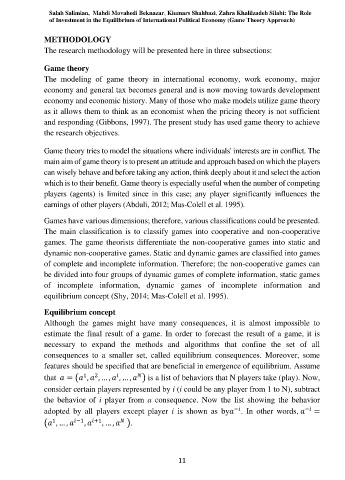
                    features should be specified that are beneficial in emergence of equilibrium. Assume

                                   2
                               1

                    that     = (   ,    , … ,    , … ,    ) is a list of behaviors that N players take (play). Now,
                    consider certain players represented by i (i could be any player from 1 to N), subtract
                    the  behavior  of  i  player  from  a  consequence.  Now  the  list  showing  the  behavior
                                                                            −
                    adopted  by  all  players  except  player  i  is  shown  as  by   .  In  other  words,    −    =

                      1
                    (   , … ,      −1 ,      +1 , … ,     ).


                                                           11

