


Page 12 - Azerbaijan State University of Economics
P. 12
THE        JOURNAL OF ECONOMIC SCIENCES: THEORY AND PRACTICE, V.79, # 2, 2022, pp. 4-18

                    It can be said that a consequence is the collection of the behavior of player i and other
                                                                                            −

                    players. In other words, the consequence a can be expressed as    = (   ,    ) (Shy,
                    2014).

                    Nash equilibrium
                    In  1951,  John  Nash  presented  a  new  concept  of  equilibrium  (previously  used  by
                    Cournot  in  studying  bilateral  monopoly)  which  turned  into  a  new  concept  of
                    equilibrium and was generally used in game analysis.


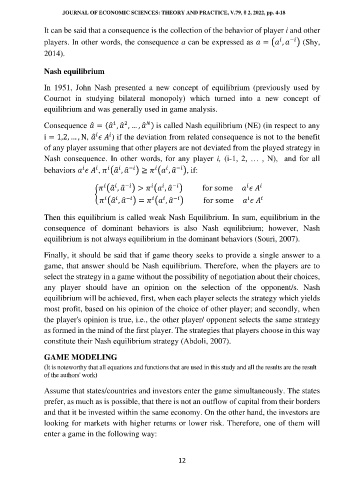
                    Consequence   ̂ = (  ̂ ,   ̂ , … ,   ̂ ) is called Nash equilibrium (NE) (in respect to any
                                        1

                                           2


                    i = 1,2, … , N,   ̂       ) if the deviation from related consequence is not to the benefit
                    of any player assuming that other players are not deviated from the played strategy in
                    Nash  consequence.  In other words,  for any player i,  (i-1, 2, … , N),  and for all
                    behaviors          ,    (  ̂ ,   ̂ ) ≥    (   ,   ̂ ), if:

                                             −


                                                           −


                                                          −

                                            −

                                       (  ̂ ,   ̂ ) >    (   ,   ̂ )           for some
                                   {
                                            −


                                                          −


                                       (  ̂ ,   ̂ ) =    (   ,   ̂ )           for some
                    Then this equilibrium is called weak Nash Equilibrium. In sum, equilibrium in the
                    consequence  of  dominant  behaviors  is  also  Nash  equilibrium;  however,  Nash
                    equilibrium is not always equilibrium in the dominant behaviors (Souri, 2007).
                    Finally, it should be said that if game theory seeks to provide a single answer to a
                    game, that answer should be Nash equilibrium. Therefore, when the players are to
                    select the strategy in a game without the possibility of negotiation about their choices,
                    any  player  should  have  an  opinion  on  the  selection  of  the  opponent/s.  Nash
                    equilibrium will be achieved, first, when each player selects the strategy which yields
                    most profit, based on his opinion of the choice of other player; and secondly, when
                    the player's opinion is true, i.e., the other player/ opponent selects the same strategy
                    as formed in the mind of the first player. The strategies that players choose in this way
                    constitute their Nash equilibrium strategy (Abdoli, 2007).
                    GAME MODELING
                    (It is noteworthy that all equations and functions that are used in this study and all the results are the result
                    of the authors' work)

                    Assume that states/countries and investors enter the game simultaneously. The states
                    prefer, as much as is possible, that there is not an outflow of capital from their borders
                    and that it be invested within the same economy. On the other hand, the investors are
                    looking for markets with higher returns or lower risk. Therefore, one of them will
                    enter a game in the following way:


                                                           12

