


Page 112 - Azerbaijan State University of Economics
P. 112
THE                     JOURNAL OF ECONOMIC SCIENCES: THEORY AND PRACTICE, V.80, # 1, 2023, pp. 106-118

                    Spearman correlation test

                    The study evaluated whether the investment choice proxies (asset growth, financial
                    leverage, and liquidity) would improve firm profitability in this part by measuring the
                    strength  of  correlation  between  the  investment  decision  variables  and  firm
                    profitability. The correlation coefficients for each variable taken into consideration in
                    this investigation are shown in Table 3.
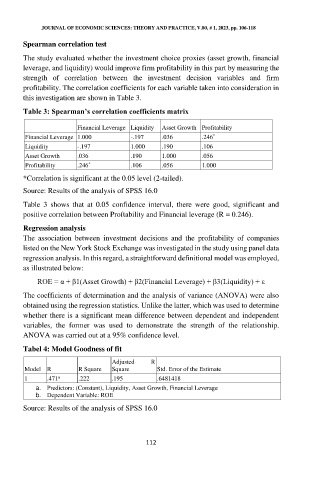
                    Table 3: Spearman’s correlation coefficients matrix


                                     Financial Leverage  Liquidity  Asset Growth  Profitability
                                                                                *
                    Financial Leverage  1.000         -.197     .036         .246
                    Liquidity        -.197            1.000     .190         .106
                    Asset Growth     .036             .190      1.000        .056
                                         *
                    Profitability    .246             .106      .056         1.000
                    *Correlation is significant at the 0.05 level (2-tailed).
                    Source: Results of the analysis of SPSS 16.0

                    Table  3  shows  that  at  0.05  confidence  interval,  there  were  good,  significant  and
                    positive correlation between Proftability and Financial leverage (R = 0.246).

                    Regression analysis
                    The  association  between  investment  decisions  and  the  profitability  of  companies
                    listed on the New York Stock Exchange was investigated in the study using panel data
                    regression analysis. In this regard, a straightforward definitional model was employed,
                    as illustrated below:

                        ROE = α + β1(Asset Growth) + β2(Financial Leverage) + β3(Liquidity) + ε

                    The coefficients of determination and the analysis of variance (ANOVA) were also
                    obtained using the regression statistics. Unlike the latter, which was used to determine
                    whether there is a significant mean difference between dependent and independent
                    variables,  the  former  was  used  to  demonstrate  the  strength  of  the  relationship.
                    ANOVA was carried out at a 95% confidence level.

                    Tabel 4: Model Goodness of fit
                                                Adjusted     R
                    Model  R         R Square   Square        Std. Error of the Estimate
                               a
                    1      .471      .222       .195          .6481418
                        a.  Predictors: (Constant), Liquidity, Asset Growth, Financial Leverage
                        b.  Dependent Variable: ROE
                    Source: Results of the analysis of SPSS 16.0


                                                           112

