


Page 115 - Azerbaijan State University of Economics
P. 115
Fettouche Fatma: Influence of Human Capital On Employment In China Standard
Analytical Study
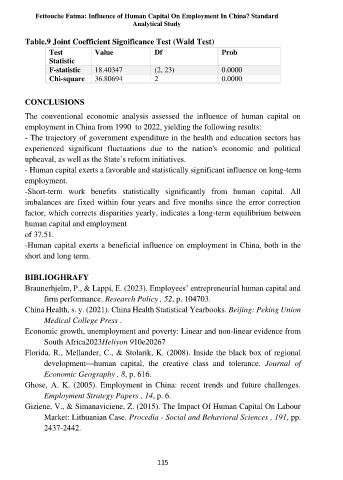
Table.9 Joint Coefficient Significance Test (Wald Test)
Test Value Df Prob
Statistic
F-statistic 18.40347 (2, 23) 0.0000
Chi-square 36.80694 2 0.0000
CONCLUSIONS
The conventional economic analysis assessed the influence of human capital on
employment in China from 1990 to 2022, yielding the following results:
- The trajectory of government expenditure in the health and education sectors has
experienced significant fluctuations due to the nation's economic and political
upheaval, as well as the State’s reform initiatives.
- Human capital exerts a favorable and statistically significant influence on long-term
employment.
-Short-term work benefits statistically significantly from human capital. All
imbalances are fixed within four years and five months since the error correction
factor, which corrects disparities yearly, indicates a long-term equilibrium between
human capital and employment
of 37.51.
-Human capital exerts a beneficial influence on employment in China, both in the
short and long term.
BIBLIOGHRAFY
Braunerhjelm, P., & Lappi, E. (2023). Employees’ entrepreneurial human capital and
firm performance. Research Policy , 52, p. 104703.
China Health, s. y. (2021). China Health Statistical Yearbooks. Beijing: Peking Union
Medical College Press .
Economic growth, unemployment and poverty: Linear and non-linear evidence from
South Africa2023Heliyon 910e20267
Florida, R., Mellander, C., & Stolarik, K. (2008). Inside the black box of regional
development—human capital, the creative class and tolerance. Journal of
Economic Geography , 8, p. 616.
Ghose, A. K. (2005). Employment in China: recent trends and future challenges.
Employment Strategy Papers , 14, p. 6.
Giziene, V., & Simanaviciene, Z. (2015). The Impact Of Human Capital On Labour
Market: Lithuanian Case. Procedia - Social and Behavioral Sciences , 191, pp.
2437-2442.
115

