


Page 110 - Azerbaijan State University of Economics
P. 110
THE                      JOURNAL OF ECONOMIC SCIENCES: THEORY AND PRACTICE, V.81, # 2, 2024, pp. 104-116

                    The data demonstrates that expenditure on general education by educational level,
                    expressed as a % of GDP, indicates that the elementary education subsector is the
                    most substantial, whereas higher and secondary education are relatively lesser. This
                    signifies that elementary education accounts for almost one-third of the GDP share,
                    indicating that China's educational system prioritises obligatory and free education.
                    The most significant investment takes place during the transition from primary to
                    secondary education, whereas pre-primary education represents just 0.2% of GDP,
                    exceeding secondary education by 0.4% between the years 2015 and 2019 (Hu, 2022).

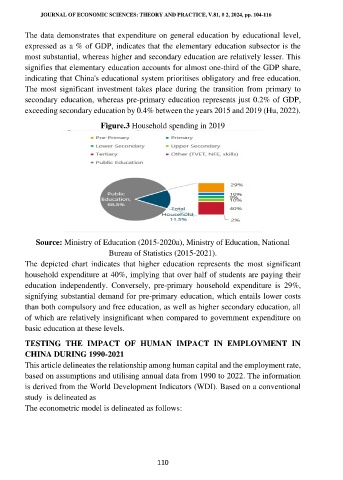
                                          Figure.3 Household spending in 2019


                       Source: Ministry of Education (2015-2020a), Ministry of Education, National
                                             Bureau of Statistics (2015-2021).
                    The  depicted  chart  indicates  that  higher  education  represents  the  most  significant
                    household expenditure at 40%, implying that over half of students are paying their
                    education  independently.  Conversely,  pre-primary  household  expenditure  is  29%,
                    signifying substantial demand for pre-primary education, which entails lower costs
                    than both compulsory and free education, as well as higher secondary education, all
                    of which are relatively insignificant when compared to government expenditure on
                    basic education at these levels.

                    TESTING  THE  IMPACT  OF  HUMAN  IMPACT  IN  EMPLOYMENT  IN
                    CHINA DURING 1990-2021
                    This article delineates the relationship among human capital and the employment rate,
                    based on assumptions and utilising annual data from 1990 to 2022. The information
                    is derived from the World Development Indicators (WDI). Based on a conventional
                    study  is delineated as
                    The econometric model is delineated as follows :


                                                           110

