


Page 12 - Azerbaijan State University of Economics
P. 12
THE                      JOURNAL OF ECONOMIC SCIENCES: THEORY AND PRACTICE, V.81, # 2, 2024, pp. 4-29


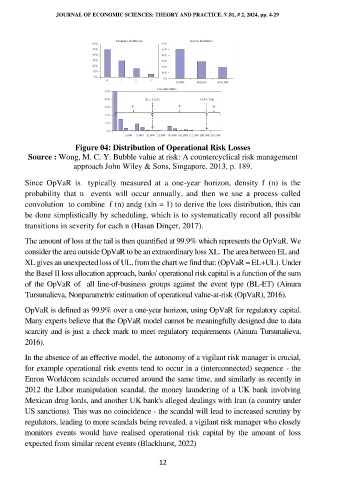
                                   Figure 04: Distribution of Operational Risk Losses
                     Source : Wong, M. C. Y. Bubble value at risk: A countercyclical risk management
                                  approach John Wiley & Sons, Singapore. 2013, p. 189.

                    Since  OpVaR  is    typically  measured  at  a  one-year  horizon,  density  f  (n)  is  the
                    probability  that  n    events  will  occur  annually,  and  then  we  use  a  process  called
                    convolution  to combine  f (n) andg (x|n = 1) to derive the loss distribution, this can
                    be done simplistically by scheduling, which is to systematically record all possible
                    transitions in severity for each n (Hasan Dinçer, 2017).

                    The amount of loss at the tail is then quantified at 99.9% which represents the OpVaR. We
                    consider the area outside OpVaR to be an extraordinary loss XL. The area between EL and
                    XL gives an unexpected loss of UL, from the chart we find that: (OpVaR = EL+UL). Under
                    the Basel II loss allocation approach, banks' operational risk capital is a function of the sum
                    of the OpVaR of  all line-of-business groups against the event type (BL-ET)  (Ainura
                    Tursunalieva, Nonparametric estimation of operational value-at-risk (OpVaR), 2016).

                    OpVaR is defined as 99.9% over a one-year horizon, using OpVaR for regulatory capital.
                    Many experts believe that the OpVaR model cannot be meaningfully designed due to data
                    scarcity and is just a check mark to meet regulatory requirements (Ainura Tursunalieva,
                    2016).

                    In the absence of an effective model, the autonomy of a vigilant risk manager is crucial,
                    for example operational risk events tend to occur in a (interconnected) sequence - the
                    Enron Worldcom scandals occurred around the same time, and similarly as recently in
                    2012 the Libor manipulation scandal, the money laundering of a UK bank involving
                    Mexican drug lords, and another UK bank's alleged dealings with Iran (a country under
                    US sanctions). This was no coincidence - the scandal will lead to increased scrutiny by
                    regulators, leading to more scandals being revealed, a vigilant risk manager who closely
                    monitors  events  would  have  realised  operational  risk  capital  by  the  amount  of  loss
                    expected from similar recent events (Blackhurst, 2022)


                                                           12

