


Page 37 - Azerbaijan State University of Economics
P. 37
Mbu Daniel Tambi, Mah-Soh Glennice Fosah: Econometric Modelling of Women
Empowerment and Agricultural Production in Cameroon
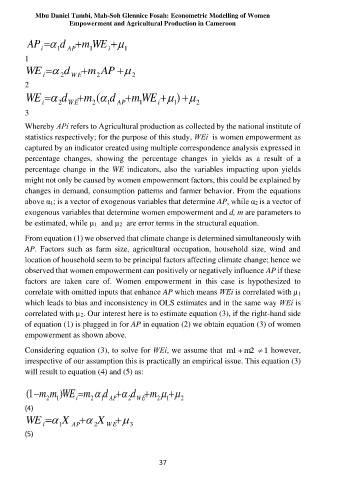
AP i = d AP + WEm 1 i + 1
1
1
WE i = d W E +m 2 AP + 2
2
2
WE i = d +m 2 ( d + WEm 1 i + ) + 2
1
1 AP
2 WE
3
Whereby APί refers to Agricultural production as collected by the national institute of
statistics respectively; for the purpose of this study, WEί is women empowerment as
captured by an indicator created using multiple correspondence analysis expressed in
percentage changes, showing the percentage changes in yields as a result of a
percentage change in the WE indicators, also the variables impacting upon yields
might not only be caused by women empowerment factors, this could be explained by
changes in demand, consumption patterns and farmer behavior. From the equations
above α1; is a vector of exogenous variables that determine AP, while α2 is a vector of
exogenous variables that determine women empowerment and d, m are parameters to
be estimated, while µ1 and µ2 are error terms in the structural equation.
From equation (1) we observed that climate change is determined simultaneously with
AP. Factors such as farm size, agricultural occupation, household size, wind and
location of household seem to be principal factors affecting climate change; hence we
observed that women empowerment can positively or negatively influence AP if these
factors are taken care of. Women empowerment in this case is hypothesized to
correlate with omitted inputs that enhance AP which means WEί is correlated with µ1
which leads to bias and inconsistency in OLS estimates and in the same way WEί is
correlated with µ2. Our interest here is to estimate equation (3), if the right-hand side
of equation (1) is plugged in for AP in equation (2) we obtain equation (3) of women
empowerment as shown above.
Considering equation (3), to solve for WEί, we assume that m1 + m2 1 however,
irrespective of our assumption this is practically an empirical issue. This equation (3)
will result to equation (4) and (5) as:
1 ( − mm 2 1 )WE i =m 2 d + d +m 2 1 + 2
1 AP
2 WE
(4)
WE i = X AP + X W E + 3
1
2
(5)
37

