


Page 24 - Azerbaijan State University of Economics
P. 24
Nina Poyda-Nosyk, Serhii Lehenchuk, Victoriia Makarovych, Iryna Polishchuk, Tetiana Zavalii: Analytical
                       Procedures in Audit As A Tool For Predicting The Risks Of Financial Statement Fraud In Marketing Companies

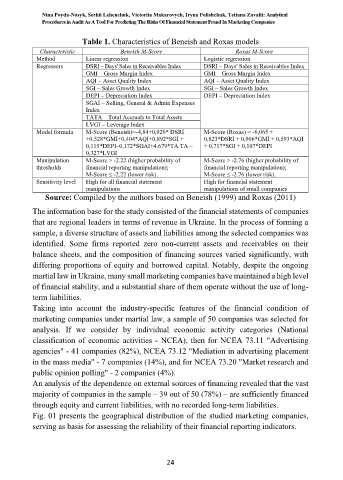
                                  Table 1. Characteristics of Beneish and Roxas models
                      Characteristic          Beneish M-Score                   Roxas M-Score
                     Method         Linear regression                 Logistic regression
                     Regressors     DSRI – Days' Sales in Receivables Index   DSRI – Days' Sales in Receivables Index
                                    GMI – Gross Margin Index          GMI – Gross Margin Index
                                    AQI – Asset Quality Index         AQI – Asset Quality Index
                                    SGI – Sales Growth Index          SGI – Sales Growth Index
                                    DEPI – Depreciation Index         DEPI – Depreciation Index
                                    SGAI – Selling, General & Admin Expenses
                                    Index
                                    TATA – Total Accruals to Total Assets
                                    LVGI – Leverage Index
                     Model formula   M-Score (Beneish)=-4,84+0,920* DSRI   M-Score (Roхas) = -6,065 +
                                    +0,528*GMI+0,404*AQI+0,892*SGI +   0,823*DSRI + 0,906*GMI + 0,593*AQI
                                    0,115*DEPI–0,172*SGAI+4,679*TA TA –   + 0,717*SGI + 0,107*DEPI
                                    0,327*LVGI
                     Manipulation   M-Score > -2.22 (higher probability of   M-Score > -2.76 (higher probability of
                     thresholds     financial reporting manipulation);   financial reporting manipulation);
                                    M-Score ≤ -2.22 (lower risk).     M-Score ≤ -2.76 (lower risk).
                     Sensitivity level   High for all financial statement   High for financial statement
                                    manipulations                     manipulations of small companies
                       Source: Compiled by the authors based on Beneish (1999) and Roxas (2011)

                    The information base for the study consisted of the financial statements of companies
                    that are regional leaders in terms of revenue in Ukraine. In the process of forming a
                    sample, a diverse structure of assets and liabilities among the selected companies was
                    identified.  Some  firms  reported  zero  non-current  assets  and  receivables  on  their
                    balance sheets, and the composition of financing sources varied significantly, with
                    differing proportions of equity and borrowed capital. Notably, despite the ongoing
                    martial law in Ukraine, many small marketing companies have maintained a high level
                    of financial stability, and a substantial share of them operate without the use of long-
                    term liabilities.
                    Taking  into  account  the  industry-specific  features  of  the  financial  condition  of
                    marketing companies under martial law, a sample of 50 companies was selected for
                    analysis.  If  we  consider  by  individual  economic  activity  categories  (National
                    classification of economic activities - NCEA), then for NCEA 73.11 "Advertising
                    agencies" - 41 companies (82%), NCEA 73.12 "Mediation in advertising placement
                    in the mass media" - 7 companies (14%), and for NCEA 73.20 "Market research and
                    public opinion polling" - 2 companies (4%).
                    An analysis of the dependence on external sources of financing revealed that the vast
                    majority of companies in the sample – 39 out of 50 (78%) – are sufficiently financed
                    through equity and current liabilities, with no recorded long-term liabilities.
                    Fig. 01 presents the geographical distribution of the studied marketing companies,
                    serving as basis for assessing the reliability of their financial reporting indicators.


                                                           24

