


Page 78 - Azerbaijan State University of Economics
P. 78
THE                      JOURNAL OF ECONOMIC SCIENCES: THEORY AND PRACTICE, V.82, # 1, 2025, pp. 70-88

                    The distribution of healthcare services based on the type of institution shows that
                    58.3% (n = 70) of services were provided by public medical institutions, while 41.7%
                    (n = 50) were delivered by private medical institutions, totaling 120 cases. Regarding
                    the  types  of  healthcare  services  received,  the  majority  were  hospital  services,
                    accounting for 52.2% (n = 71) of cases. Polyclinics provided 24.3% (n = 33) of the
                    services, followed by medical stations at 7.4% (n = 10). Other service types included
                    outpatient  and  inpatient  services  (5.1%,  n  =  7),  doctor’s  offices  (5.1%,  n  =  7),
                    outpatient services only (4.4%, n = 6), and hygiene and epidemiology centers (1.5%,
                    n = 2). The total number of healthcare service instances recorded was 136.
                    Research Model And Hypotheses
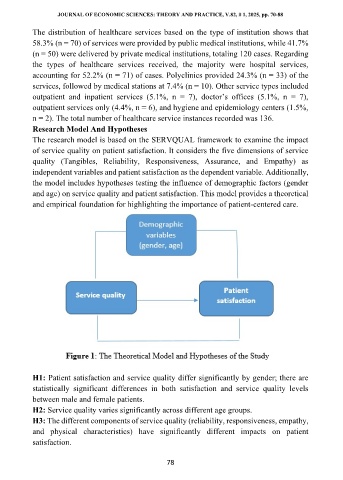
                    The research model is based on the SERVQUAL framework to examine the impact
                    of service quality on patient satisfaction. It considers the five dimensions of service
                    quality  (Tangibles,  Reliability,  Responsiveness,  Assurance,  and  Empathy)  as
                    independent variables and patient satisfaction as the dependent variable. Additionally,
                    the model includes hypotheses testing the influence of demographic factors (gender
                    and age) on service quality and patient satisfaction. This model provides a theoretical
                    and empirical foundation for highlighting the importance of patient-centered care.


                    H1: Patient satisfaction and service quality differ significantly by gender; there are
                    statistically  significant  differences  in  both  satisfaction  and  service  quality  levels
                    between male and female patients.
                    H2: Service quality varies significantly across different age groups.
                    H3: The different components of service quality (reliability, responsiveness, empathy,
                    and  physical  characteristics)  have  significantly  different  impacts  on  patient
                    satisfaction.


                                                           78

