


Page 14 - Azerbaijan State University of Economics
P. 14
THE                      JOURNAL OF ECONOMIC SCIENCES: THEORY AND PRACTICE, V.82, # 2, 2025, pp. 4-31


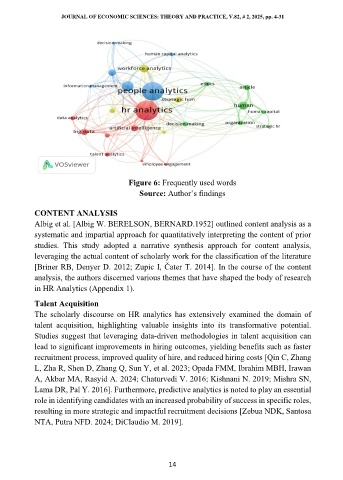
                                                Figure 6: Frequently used words
                                                   Source: Author’s findings


                    CONTENT ANALYSIS
                    Albig et al. [Albig W. BERELSON, BERNARD.1952] outlined content analysis as a
                    systematic and impartial approach for quantitatively interpreting the content of prior
                    studies.  This  study  adopted  a  narrative  synthesis  approach  for  content  analysis,
                    leveraging the actual content of scholarly work for the classification of the literature
                    [Briner RB, Denyer D. 2012; Zupic I, Čater T. 2014]. In the course of the content
                    analysis, the authors discerned various themes that have shaped the body of research
                    in HR Analytics (Appendix 1).

                    Talent Acquisition
                    The scholarly  discourse on HR analytics has  extensively  examined the domain of
                    talent  acquisition,  highlighting  valuable  insights  into  its  transformative  potential.
                    Studies suggest that leveraging data-driven methodologies in talent acquisition can
                    lead to significant improvements in hiring outcomes, yielding benefits such as faster
                    recruitment process, improved quality of hire, and reduced hiring costs [Qin C, Zhang
                    L, Zha R, Shen D, Zhang Q, Sun Y, et al. 2023; Opada FMM, Ibrahim MBH, Irawan
                    A, Akbar MA, Rasyid A. 2024; Chaturvedi V. 2016; Kishnani N. 2019; Mishra SN,
                    Lama DR, Pal Y. 2016]. Furthermore, predictive analytics is noted to play an essential
                    role in identifying candidates with an increased probability of success in specific roles,
                    resulting in more strategic and impactful recruitment decisions [Zebua NDK, Santosa
                    NTA, Putra NFD. 2024; DiClaudio M. 2019].


                                                           14

