Home
Home Site map
 Contacts
 Volume 82, #1
“Economic Sciences: theory and practice” is scientific, refereed, biannual journal. The Journal of “Economic Sciences: theory and practice” has been founded by Azerbaijan Sta...
 Volume 82, #2
“Economic Sciences: theory and practice” is scientific, refereed, biannual journal. The Journal of “Economic Sciences: theory and practice” has been founded by Azerbaijan Sta...
 Volume 81, #1
“Economic Sciences: theory and practice” is scientific, refereed, biannual journal. The Journal of “Economic Sciences: theory and practice” has been founded by Azerbaijan Sta...
 Volume 81, #2
“Economic Sciences: theory and practice” is scientific, refereed, biannual journal. The Journal of “Economic Sciences: theory and practice” has been founded by Azerbaijan Sta...
 Volume 80, #1
“Economic Sciences: theory and practice” is scientific, refereed, biannual journal. The Journal of “Economic Sciences: theory and practice” has been founded by Azerbaijan Sta...
 Volume 80, #2
“Economic Sciences: theory and practice” is scientific, refereed, biannual journal. The Journal of “Economic Sciences: theory and practice” has been founded by Azerbaijan Sta...
 Volume 79, #1
“Economic Sciences: theory and practice” is scientific, refereed, biannual journal. The Journal of “Economic Sciences: theory and practice” has been founded by Azerbaijan Sta...
 Volume 79, #2
“Economic Sciences: theory and practice” is scientific, refereed, biannual journal. The Journal of “Economic Sciences: theory and practice” has been founded by Azerbaijan Sta...
 Volume 78, #1
“Economic Sciences: theory and practice” is scientific, refereed, biannual journal. The Journal of “Economic Sciences: theory and practice” has been founded by Azerbaijan Sta...
 Volume 78, #2
“Economic Sciences: theory and practice” is scientific, refereed, biannual journal. The Journal of “Economic Sciences: theory and practice” has been founded by Azerbaijan Sta...
Journal
Volume 82, #2 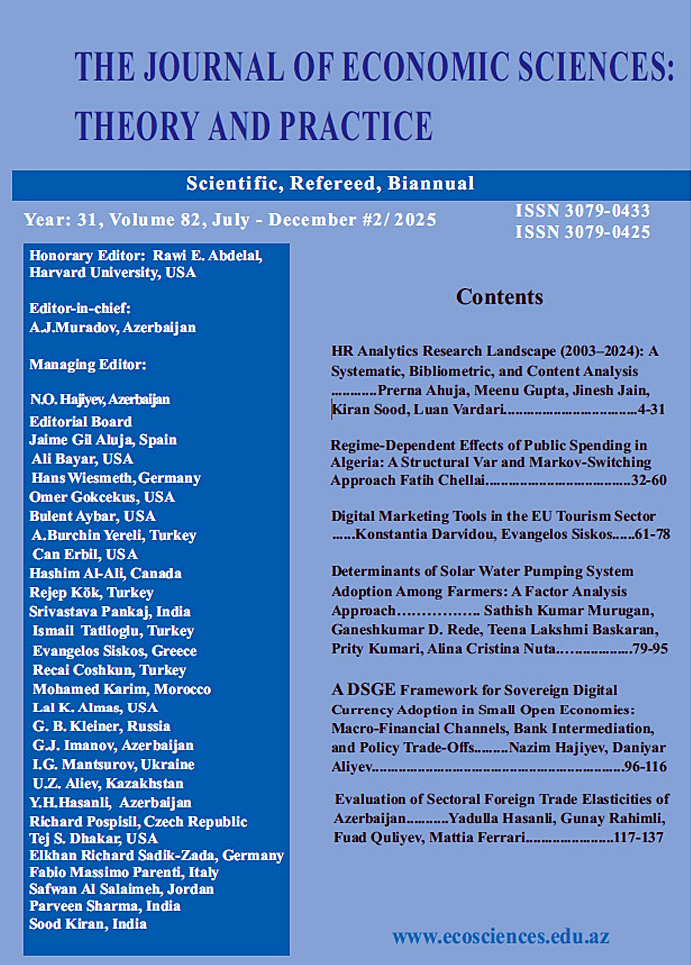
“Economic Sciences: theory and practice” is scientific, refereed, biannual journal. The Journal of “Economic Sciences: theory and practice” has been founded by Azerbaijan State University of Economics in 1994.
The Journal has been received to registration in the centre of international ISSN (International Standard Series Number, ISSN-2220-8739). Also, it has been included by the Supreme attestation Commission under the President of Azerbaijan Republic to the list of scientific publications on economic sciences.
Multimedia
About article
REGIME-DEPENDENT EFFECTS OF PUBLIC SPENDING IN ALGERIA: A STRUCTURAL VAR AND MARKOV-SWITCHING APPROACH
Fatih CHELLAI
Keywords: Public expenditure; Economic growth; SVAR; Oil price; Fiscal policy
JEL Codes: E62; C32; O55; Q43
Full text
Fatih CHELLAI
ABSTRACT
Purpose - This study examines the macroeconomic effects of public spending in Algeria between 2000 and 2023, focusing on its role in growth, inflation, and employment within a resource-dependent economy. The research investigates how fiscal shocks, under different economic regimes, shape Algeria’s structural vulnerabilities and development trajectory. Design/methodology/approach – A Structural Vector Autoregressive (SVAR) model is employed to identify and analyze the transmission of fiscal shocks on GDP, inflation, and unemployment, with oil prices treated exogenously. To capture nonlinearities and regime-dependent behaviors, a Markov-Switching VAR (MS-VAR) framework complements the baseline model. Impulse response functions and variance decomposition are used to assess dynamic interactions. Findings – Results indicate that public spending generates short-term GDP gains, reduces unemployment, and induces inflationary pressures, but these effects are highly contingent on oil revenues. Regime-switching dynamics reveal that fiscal multipliers are stronger in stable periods and weaker during volatile or crisis regimes. Algeria’s persistent exposure to high-volatility regimes underscores structural fragility and fiscal dependence on hydrocarbons. Research limitations/implications - The analysis is limited by annual data availability and the specific modeling assumptions of SVAR/MS-VAR frameworks. Future studies could integrate sectoral expenditure data and higher-frequency series to enrich the robustness of findings. Practical implications – The findings stress the need for countercyclical fiscal buffers, diversification of revenue sources, and governance reforms to reduce oil dependency. Effective fiscal policy in Algeria requires adaptive frameworks that account for regime shifts and external shocks. Originality/value – This study enriches the literature on fiscal policy in rentier economies by combining SVAR and regime-switching approaches, highlighting the state-contingent nature of fiscal multipliers. It provides actionable insights for policymakers aiming to balance stabilization, growth, and resilience in volatile economic environments.
Keywords: Public expenditure; Economic growth; SVAR; Oil price; Fiscal policy
JEL Codes: E62; C32; O55; Q43
Full text
Buy PDF file (0) | Back | Top