Home
Home Site map
 Contacts
 Volume 82, #1
“Economic Sciences: theory and practice” is scientific, refereed, biannual journal. The Journal of “Economic Sciences: theory and practice” has been founded by Azerbaijan Sta...
 Volume 82, #2
“Economic Sciences: theory and practice” is scientific, refereed, biannual journal. The Journal of “Economic Sciences: theory and practice” has been founded by Azerbaijan Sta...
 Volume 81, #1
“Economic Sciences: theory and practice” is scientific, refereed, biannual journal. The Journal of “Economic Sciences: theory and practice” has been founded by Azerbaijan Sta...
 Volume 81, #2
“Economic Sciences: theory and practice” is scientific, refereed, biannual journal. The Journal of “Economic Sciences: theory and practice” has been founded by Azerbaijan Sta...
 Volume 80, #1
“Economic Sciences: theory and practice” is scientific, refereed, biannual journal. The Journal of “Economic Sciences: theory and practice” has been founded by Azerbaijan Sta...
 Volume 80, #2
“Economic Sciences: theory and practice” is scientific, refereed, biannual journal. The Journal of “Economic Sciences: theory and practice” has been founded by Azerbaijan Sta...
 Volume 79, #1
“Economic Sciences: theory and practice” is scientific, refereed, biannual journal. The Journal of “Economic Sciences: theory and practice” has been founded by Azerbaijan Sta...
 Volume 79, #2
“Economic Sciences: theory and practice” is scientific, refereed, biannual journal. The Journal of “Economic Sciences: theory and practice” has been founded by Azerbaijan Sta...
 Volume 78, #1
“Economic Sciences: theory and practice” is scientific, refereed, biannual journal. The Journal of “Economic Sciences: theory and practice” has been founded by Azerbaijan Sta...
 Volume 78, #2
“Economic Sciences: theory and practice” is scientific, refereed, biannual journal. The Journal of “Economic Sciences: theory and practice” has been founded by Azerbaijan Sta...
Journal
Volume 82, #2 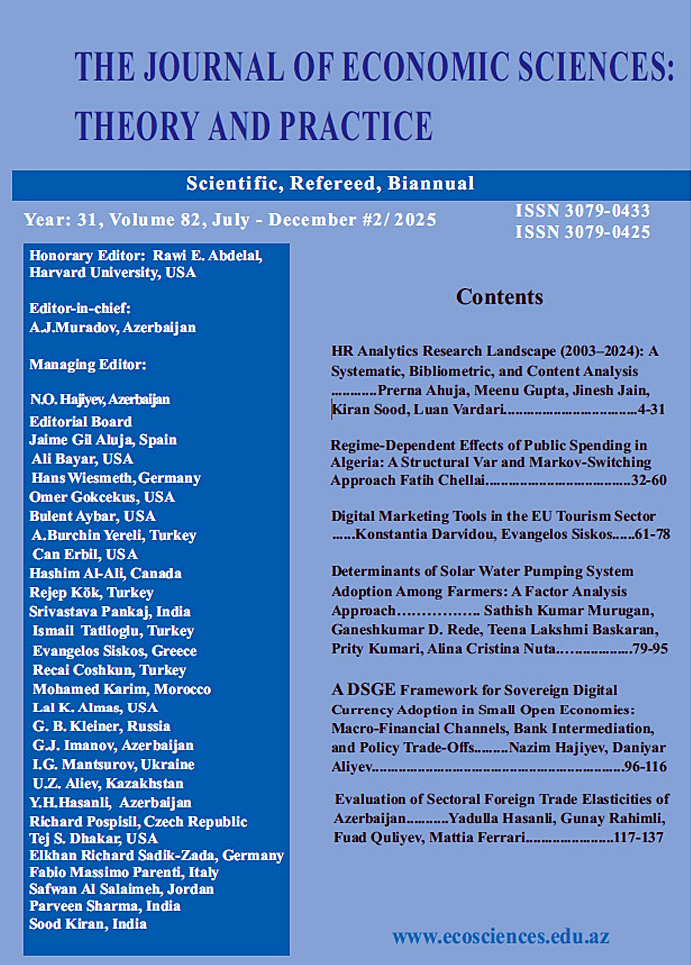
“Economic Sciences: theory and practice” is scientific, refereed, biannual journal. The Journal of “Economic Sciences: theory and practice” has been founded by Azerbaijan State University of Economics in 1994.
The Journal has been received to registration in the centre of international ISSN (International Standard Series Number, ISSN-2220-8739). Also, it has been included by the Supreme attestation Commission under the President of Azerbaijan Republic to the list of scientific publications on economic sciences.
Multimedia
About article
A DSGE FRAMEWORK FOR SOVEREIGN DIGITAL CURRENCY ADOPTION IN SMALL OPEN ECONOMIES: MACRO-FINANCIAL CHANNELS, BANK INTERMEDIATION, AND POLICY TRADE-OFFS
Nazim Hajiyev, Daniyar Aliyev
Keywords: SDC, CBDC, Small Open Economy, DSGE, Bank Intermediation.
JEL codes: E52, E44, F41, G21
Full text
Nazim Hajiyev, Daniyar Aliyev
ABSTRACT
We build a tractable small-open-economy Dynamic Stochastic General Equilibrium (DSGE) model with monopolistically competitive banks to study the macro-financial effects of introducing a sovereign digital currency (SDC) - here modeled as an account-based central bank digital currency (CBDC). Households choose between bank deposits and SDC holdings; banks finance loans largely with deposits and face a reduced-form intermediation capacity. Mechanism — higher attractiveness of an interest-bearing SDC mechanically substitutes away bank deposits, reducing bank funding and, absent recycling, shrinking loan supply and lowering aggregate credit. Quantitatively, under our baseline calibration a 10% reallocation from bank deposits into SDC implies an≈3.2% contraction in bank lending and a consumption-equivalent welfare loss of ≈0.039% (worst-case scenarios reach ≈8.0% welfare loss when recycling is absent and intermediation is fragile). Policy experiments show that (i) modest or tiered remuneration on SDC, (ii) limits/tiering on holdings, and (iii) active central-bank recycling of inflows into bank funding substantially mitigate credit and welfare losses. Our results are robust across parameter sweeps. Policy implication — combining tiered remuneration with credible recycling is the most effective way to preserve credit while delivering the liquidity and payment-system benefits of SDC. Limitations — the analysis is theoretical, uses a reduced-form banking block and illustrative calibration; country-level empirical calibration and endogenous bank-risk dynamics are left for future work.
Keywords: SDC, CBDC, Small Open Economy, DSGE, Bank Intermediation.
JEL codes: E52, E44, F41, G21
Full text
Buy PDF file (0) | Back | Top