


Page 80 - Azerbaijan State University of Economics
P. 80
THE JOURNAL OF ECONOMIC SCIENCES: THEORY AND PRACTICE


               estimate the trade balance model correctly. Therefore, an econometric

               method of vector auto regressions (VAR), not a conventional OLS,
               should be employed. A VAR model and an impulse response function

               would take the feedback effects into account.
                     In the preliminary stage, a set of unit-root tests must be carried out

               to ensure that at least two of the variables in each of the two long-run

               equations has a unit root. It’s foremost important for a model to carry
               sound economic relevance, and not merely to satisfy specific

               econometric properties. Should a variable have a unit root in the level
               form, stationary is obtained usually by first-differencing. Such variable

               is said to be I(1) in first differences. Co integration, a key element of this

               process, is established if the variables are individually I(1), or at least
               two or more of them are. See Hansen and Juselius (1995:1) for a

               thorough description of the co integration procedure.
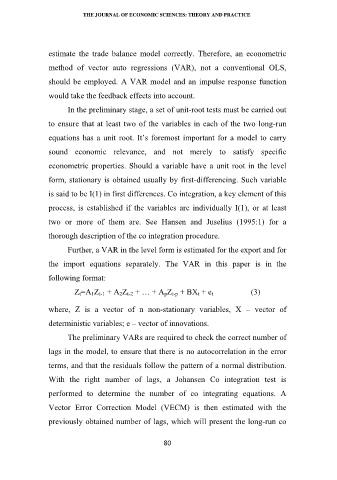
                     Further, a VAR in the level form is estimated for the export and for

               the import equations separately. The VAR in this paper is in the
               following format:

                       Z t=A 1Z t-1 + A 2Z t-2 + … + A pZ t-p + BX t + e t                   (3)

               where, Z is a vector of n non-stationary variables, X – vector of

               deterministic variables; e – vector of innovations.

                     The preliminary VARs are required to check the correct number of
               lags in the model, to ensure that there is no autocorrelation in the error

               terms, and that the residuals follow the pattern of a normal distribution.
               With the right number of lags, a Johansen Co integration test is

               performed to determine the number of co integrating equations. A
               Vector Error Correction Model (VECM) is then estimated with the

               previously obtained number of lags, which will present the long-run co


                                                 80

