


Page 83 - Azerbaijan State University of Economics
P. 83
J-CURVE AND THE MARSHALL-LERNER CONDITION - THE CASE OF AZERBAIJAN


                     The proof of the Marshall-Lerner condition is thus straightforward:

               the sum of the export and import elasticity’s exceeds unity. Therefore,
               according to this model setup, a depreciation of manat should improve the

               Azerbaijani trade balance in the long run. A combined effect of the trade
               balance response would be a 1.352% (1.465-0.113) improvement following

               a 100 basis point devaluation of the  currency. The non-oil exports in

               Azerbaijan are significantly more sensitive to the exchange rate fluctuations
               than imports, as implied by the differential in the absolute values of the two

               elasticity’s. Furthermore, due to the high positive Y eur coefficient, non-oil
               exports are said to be demand driven. Imports, on the other side, are

               evidently more supply dependent and demand independent, due to the very

               low Y az  coefficient. The sign of the coefficient is negative, while theory
               would predict it to be positive. However, the sign matters little if the value

               is close enough to zero, as is the case here.
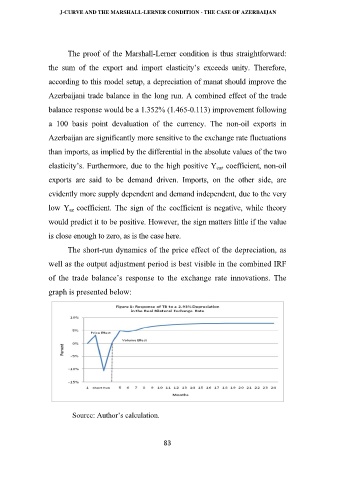
                     The short-run dynamics of the price effect of the depreciation, as

               well as the output adjustment period is best visible in the combined IRF
               of the trade balance’s response to the exchange rate innovations. The

               graph is presented below:


                      Source: Author’s calculation.


                                                 83

