


Page 85 - Azerbaijan State University of Economics
P. 85
J-CURVE AND THE MARSHALL-LERNER CONDITION - THE CASE OF AZERBAIJAN


                     There are no  a priori sign expectations  for the two price

               coefficients, since we do not know the long run behavior of prices and
               aim to find out exactly that. However, one expects the short run

               movement of the ratio of the two prices to be downwards. What happens
               from that point on is unknown. The combined IRF of the price indices’

               response to the exchange rate innovations, taken from the new VECMs,

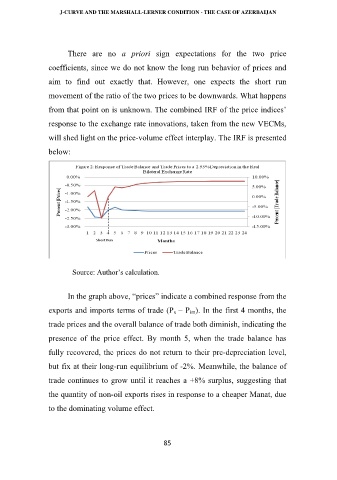
               will shed light on the price-volume effect interplay. The IRF is presented
               below:


                      Source: Author’s calculation.

                     In the graph above, “prices” indicate a combined response from the
               exports and imports terms of trade (P x  – P im). In the first 4 months, the

               trade prices and the overall balance of trade both diminish, indicating the

               presence of the price effect. By  month 5, when the trade balance has
               fully recovered, the prices do not return to their pre-depreciation level,

               but fix at their long-run equilibrium of -2%. Meanwhile, the balance of
               trade continues to grow until it reaches a +8% surplus, suggesting that

               the quantity of non-oil exports rises in response to a cheaper Manat, due
               to the dominating volume effect.


                                                 85

