


Page 82 - Azerbaijan State University of Economics
P. 82
THE JOURNAL OF ECONOMIC SCIENCES: THEORY AND PRACTICE


                     Based on the unit root tests’ results, it is clear that each of the two

               demand equations has at least two I(1) variables. Therefore, the Johansen
               approach to estimation is applicable.

               Vector Auto Regressions
                     When constructing the VAR models, one lag was initially selected

               as the starting point of analysis. Following the lag  structure test,

               however, the export demand VAR is continued with three lags, and the
               import demand VAR – with two. An  autocorrelation test shows no

               problems with error autocorrelation. Similarly, the normality test affirms
               that all residuals are normally distributed. Generally, problems of

               autocorrelation and normality can be solved by adding more lags to the

               system. However, our analysis proceeds without any required
               interventions. Results of the autocorrelation and normality tests are not

               presented here for brevity.
                     Vector Error Correction Models

                     The Johansen co integration test is performed for both demand
               functions to reveal the number of  long-run co integrating equations.

               Each of the two functions has one co integrating equation, which

               significantly eases the economic interpretation of the model. Further, the
               VEC model is estimated with the N-1 lags, where N is the number of

               lags in the respective preliminary VAR. Selection of deterministic
               elements is the following: intercept but no trend for the co integrating

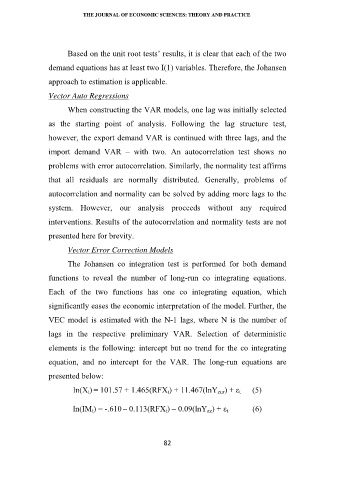
               equation, and no intercept for the VAR. The long-run equations are
               presented below:

                       ln(X t)  = 101.57 + 1.465(RFX t) + 11.467(lnY eur) + ε t      (5)


                       ln(IM t) = -.610  – 0.113(RFX t) – 0.09(lnY az) + ε t                 (6)


                                                 82

