


Page 12 - Azerbaijan State University of Economics
P. 12
XiaolinQu, M.S., Lal K. Almas:  The water requirement and profitability analysis of corn using irrigation
                                                                             management approaches including evapotranspiration and weather data


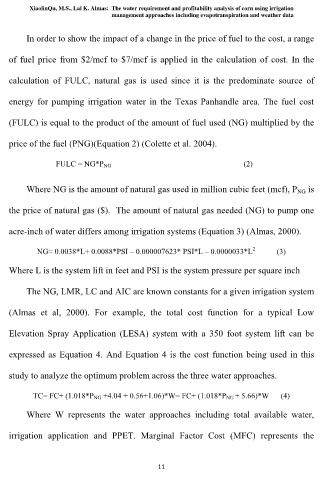
                    In order to show the impact of a change in the price of fuel to the cost, a range


               of fuel price from $2/mcf to $7/mcf is applied in the calculation of cost. In the


               calculation of FULC, natural gas is used  since it is the predominate source of


               energy for pumping irrigation water in the Texas Panhandle area. The fuel cost


               (FULC) is equal to the product of the amount of fuel used (NG) multiplied by the


               price of the fuel (PNG)(Equation 2) (Colette et al. 2004).


                             FULC = NG*P NG                                          (2)


                    Where NG is the amount of natural gas used in million cubic feet (mcf), P NG is


               the price of natural gas ($).  The amount of natural gas needed (NG) to pump one


               acre-inch of water differs among irrigation systems (Equation 3) (Almas, 2000).


                                                                                        2
                       NG= 0.0038*L+ 0.0088*PSI – 0.000007623* PSI*L – 0.0000033*L            (3)
               Where L is the system lift in feet and PSI is the system pressure per square inch


                    The NG, LMR, LC and AIC are known constants for a given irrigation system


               (Almas et al, 2000). For example, the  total cost function for a typical Low


               Elevation Spray Application (LESA) system with a 350 foot system lift can be


               expressed as Equation 4. And Equation 4 is the cost function being used in this


               study to analyze the optimum problem across the three water approaches.


                      TC= FC+ (1.018*P NG +4.04 + 0.56+1.06)*W= FC+ (1.018*P NG + 5.66)*W      (4)

                    Where W represents  the water approaches  including total available water,


               irrigation application and PPET. Marginal Factor Cost (MFC) represents the


                                                            11

