


Page 14 - Azerbaijan State University of Economics
P. 14
XiaolinQu, M.S., Lal K. Almas: The water requirement and profitability analysis of corn using irrigation
management approaches including evapotranspiration and weather data
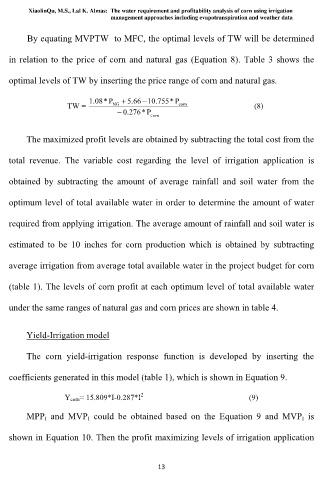
By equating MVPTW to MFC, the optimal levels of TW will be determined
in relation to the price of corn and natural gas (Equation 8). Table 3 shows the
optimal levels of TW by inserting the price range of corn and natural gas.
. 1 08 * P . 5 66 10 . 755 * P
TW = NG corn (8)
. 0 276 * P c orn
The maximized profit levels are obtained by subtracting the total cost from the
total revenue. The variable cost regarding the level of irrigation application is
obtained by subtracting the amount of average rainfall and soil water from the
optimum level of total available water in order to determine the amount of water
required from applying irrigation. The average amount of rainfall and soil water is
estimated to be 10 inches for corn production which is obtained by subtracting
average irrigation from average total available water in the project budget for corn
(table 1). The levels of corn profit at each optimum level of total available water
under the same ranges of natural gas and corn prices are shown in table 4.
Yield-Irrigation model
The corn yield-irrigation response function is developed by inserting the
coefficients generated in this model (table 1), which is shown in Equation 9.
Y corn= 15.809*I-0.287*I 2 (9)
MPP I and MVP I could be obtained based on the Equation 9 and MVP I is
shown in Equation 10. Then the profit maximizing levels of irrigation application
13

