


Page 21 - Azerbaijan State University of Economics
P. 21
Hashim Al-Ali: Towards a realistic medium term macroeconomic and fiscal framework and
                                                 outlook for the Somali national economy (2017- 2019)


               likely contributions of the main sectors of the Somali economy to GDP, and each of these sectors
               resulting compound real annual rate of growth, applying both assumed growth scenarios of GDP,
               i.e. the Baseline and the Hopeful Scenario, during the period 2016 to 2019.


                   																							Table -3-  The Planned Structure of the Somali Economy during the SNDP Period
                    Baseline Scenario                            Hopeful Scenario
                                        Percentage     Annual                         Percentage     Annual
                    Sectoral Clustering   Share of the  Growth   Sectoral Clustering   Share of the   Growth
                                          GDP       Rate (%)                            GDP       Rate (%)
                                       2016  2019  (2017-2019)                       2016   2019  2017-2019)

                    Productive Sector   63.8   62.1     2.1      Productive Sector   63.8   62.1     4.6
                      Infrastructure                               Infrastructure
                         Sector         4.2   7.2      23.3           Sector         4.2    7.2     26.2
                     Social and Other   32.0   30.7     1.6       Social and Other   32.0   30.7
                      Services Sector                              Services Sector                   4.1
                       Total (GDP)      100   100       3.0         Total (GDP)      100    100      5.5

                       Source: Integrated Macro Modelling Results
               Besides, the trade and financial services sectors are expected to play a leading role in economic
               development and in creating jobs. These sectors would be taking advantage of the opportunities
               offered through and by developing the road, port, communication, utilities sectors and activities
               within the national economy during the SNDP period. Within this assuming sectoral setting, the
               mining  and  tourism  sectors  are  expected  to  be  developed  further,  improved  and  emerged  as
               among the key sectors in the economy, given the favorable location and subject to improved
               security situation of the Somalia.

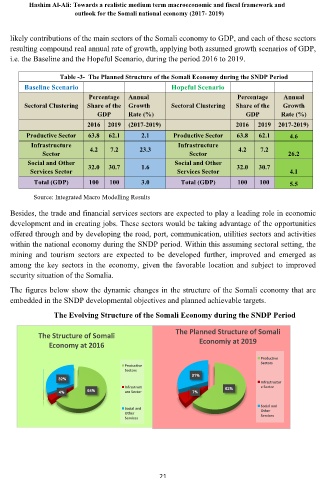
               The figures below show the dynamic changes in the structure of the Somali economy that are
               embedded in the SNDP developmental objectives and planned achievable targets.

                             The Evolving Structure of the Somali Economy during the SNDP Period


                 	                                                The	Planned	Structure	of	Somali
                        The	Structure	of	Somali
                 	         Economy	at	2016                               Economiy	at	2019

                                                                                             Productive
                                                   Productive	                               Sectors

                                                   Sectors
                              32%                                        31%

                                                   Infrastruct                               Infrastructur
                                                                                            e	Sector


                              4%       64%         ure	Sector             7%      62%


                                                   Social	and	                               Social	and
                                                                                            Other
                                                   Other	                                   Services
                                                   Services


               	                                             21

