


Page 24 - Azerbaijan State University of Economics
P. 24
THE JOURNAL OF ECONOMIC SCIENCES: THEORY AND PRACTICE, V.74, # 2, 2017, pp. 4-31


               Given the above reality of the labour market in Somalia, and given the fact that the emphasis
               would be focused on utilizing fully the available human resources, and its skill contents, to create
               and  achieve,  the  aimed  at,  sustainable  national  development  and  growth,  the  SNDP  has
               attempted to forecasting the employment likely would be generated, by main sector clustering, in
               the  economy  for  the  next  few  years  (2016-2019).  This  sectoral-employment  structuring  is
               derived  using  relevant  parameters  and  coefficients  such  as;  sectoral  planned  growth  rates,
               sectoral  calculated  labour-output  ratios  (LOR),  the  likely  national  and  sectoral  absorptive
               capacity  and  investment,  as  well  as  the  calculated  labour  productivity,  both  level  and  growth
               rate, as obtained from solving the aggregated model and shown. The table below displays the
               employment by main sectors and in the economy as a whole, during the SNDP period.

                      					Table	-5-:					Projected	Pecentage	of	Employment	by	main	Sectors
                      Sectoral	Clustering	         	 2016      2017           2018             2019
                      Productive	Sector           2033.7     2148.9         2236.0            2378.3
                      Infrastruture                 143.7     175.2          226.2             309.1
                      Services                      639.4     698.0          816.4             949.1

                      Total	Economy               2816.8     3021.5         3278.6            3636.5

                                           Source: Integrated Macro Modelling outcomes

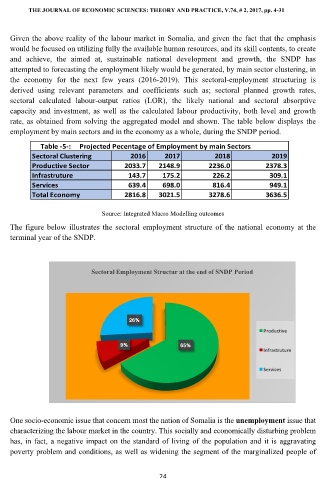
               The figure below illustrates the sectoral employment structure of the national economy at the
               terminal year of the SNDP.


                                        Sectoral Employment Structur at the end of SNDP Period


                                                    26%
               	                                                                             Productive

               	                                 9%                65%                       Infrastruture


                                                                                             Services


               One socio-economic issue that concern most the nation of Somalia is the unemployment issue that
               characterizing the labour market in the country. This socially and economically disturbing problem
               has, in fact, a negative impact on the standard of living of the population and it is aggravating
               poverty problem and conditions, as well as widening the segment of the marginalized people of


               	                                             24

