


Page 23 - Azerbaijan State University of Economics
P. 23
Hashim Al-Ali: Towards a realistic medium term macroeconomic and fiscal framework and
                                                 outlook for the Somali national economy (2017- 2019)


               large, that at present in Somalia; a high percentage of females are working in a private informal and
               unprotected jobs. This reality necessitating the need to prepare and implement a social security law
               that covers all workers in private sector activities.] base perspective, is adopting an approach based
               on  economic  empowerment  of  female  through  micro  finance,  private  sector  development  and
               monetary policies, to enhance and increase female contributions to the development, thus advancing
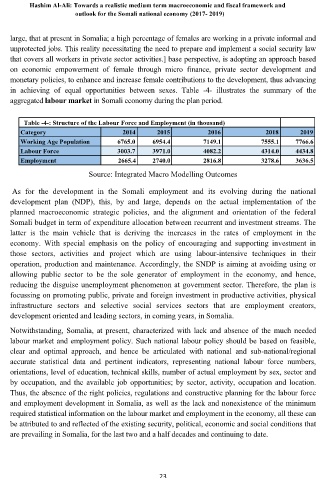
               in  achieving  of  equal  opportunities  between  sexes.  Table  -4-  illustrates  the  summary  of  the
               aggregated labour market in Somali economy during the plan period.
                                                    28                                               2816.76
                     Table -4-: Structure of the Labour Force and Employment (in thousand)
                   Category                       2014      2015            2016              2018      2019
                   Working Age Population       6765.0     6954.4          7149.1           7555.1     7766.6
                   Labour Force                 3003.7     3971.0          4082.2           4314.0     4434.8
                   Employment                   2665.4     2740.0          2816.8           3278.6     3636.5

                                       Source: Integrated Macro Modelling Outcomes

                As  for  the  development  in  the  Somali  employment  and  its  evolving  during  the  national
               development  plan  (NDP),  this,  by  and  large,  depends  on  the  actual  implementation  of  the
               planned  macroeconomic  strategic  policies,  and  the  alignment  and  orientation  of  the  federal
               Somali budget in term of expenditure allocation between recurrent and investment streams. The
               latter  is  the  main  vehicle  that  is  deriving  the  increases  in  the  rates  of  employment  in  the
               economy.  With  special  emphasis  on  the  policy  of  encouraging  and  supporting  investment  in
               those  sectors,  activities  and  project  which  are  using  labour-intensive  techniques  in  their
               operation, production and maintenance. Accordingly, the SNDP is aiming at avoiding using or
               allowing  public  sector  to  be  the  sole  generator  of  employment  in  the  economy,  and  hence,
               reducing the disguise unemployment phenomenon at government sector. Therefore, the plan is
               focussing on promoting public, private and foreign investment in productive activities, physical
               infrastructure  sectors  and  selective  social  services  sectors  that  are  employment  creators,
               development oriented and leading sectors, in coming years, in Somalia.

               Notwithstanding,  Somalia,  at  present,  characterized  with  lack  and  absence  of  the  much  needed
               labour market and employment policy. Such national labour policy should be based on feasible,
               clear  and  optimal  approach,  and  hence  be  articulated  with  national  and  sub-national/regional
               accurate  statistical  data  and  pertinent  indicators,  representing  national  labour  force  numbers,
               orientations, level of education, technical skills, number of actual employment by sex, sector and
               by occupation, and the available job opportunities; by sector, activity, occupation and location.
               Thus, the absence of the right policies, regulations and constructive planning for the labour force
               and employment development in Somalia, as well as the lack and nonexistence of the minimum
               required statistical information on the labour market and employment in the economy, all these can
               be attributed to and reflected of the existing security, political, economic and social conditions that
               are prevailing in Somalia, for the last two and a half decades and continuing to date.


               	                                             23

