


Page 71 - Azerbaijan State University of Economics
P. 71
Tuba Bingöl, Leila Samii, Tej Dhakar: Co-Communication and Brand Reflection in Higher Education:
                                                                                        Perceptions of Enrollment Intention and Recommending

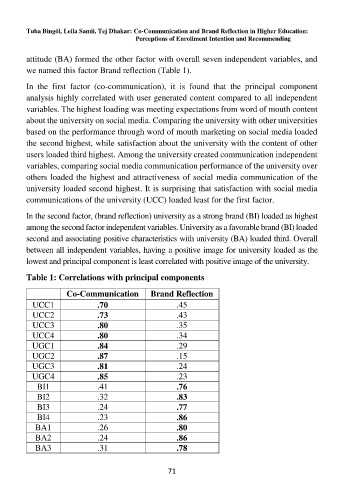
                    attitude (BA) formed the other factor with overall seven independent variables, and
                    we named this factor Brand reflection (Table 1).

                    In  the  first  factor  (co-communication),  it  is  found  that  the  principal  component
                    analysis highly correlated with user generated content compared to all independent
                    variables. The highest loading was meeting expectations from word of mouth content
                    about the university on social media. Comparing the university with other universities
                    based on the performance through word of mouth marketing on social media loaded
                    the second highest, while satisfaction about the university with the content of other
                    users loaded third highest. Among the university created communication independent
                    variables, comparing social media communication performance of the university over
                    others loaded the highest and attractiveness of social media communication of the
                    university loaded second highest. It is surprising that satisfaction with social media
                    communications of the university (UCC) loaded least for the first factor.

                    In the second factor, (brand reflection) university as a strong brand (BI) loaded as highest
                    among the second factor independent variables. University as a favorable brand (BI) loaded
                    second and associating positive characteristics with university (BA) loaded third. Overall
                    between all independent variables, having a positive image for university loaded as the
                    lowest and principal component is least correlated with positive image of the university.

                    Table 1: Correlations with principal components

                               Co-Communication        Brand Reflection
                     UCC1               .70                   .45
                     UCC2               .73                   .43
                     UCC3               .80                   .35
                     UCC4               .80                   .34
                     UGC1               .84                   .29
                     UGC2               .87                   .15
                     UGC3               .81                   .24
                     UGC4               .85                   .23
                       BI1              .41                   .76
                       BI2              .32                   .83
                       BI3              .24                   .77
                       BI4              .23                   .86
                      BA1               .26                   .80
                      BA2               .24                   .86
                      BA3               .31                   .78

                                                           71

