


Page 73 - Azerbaijan State University of Economics
P. 73
Tuba Bingöl, Leila Samii, Tej Dhakar: Co-Communication and Brand Reflection in Higher Education:
                                                                                        Perceptions of Enrollment Intention and Recommending

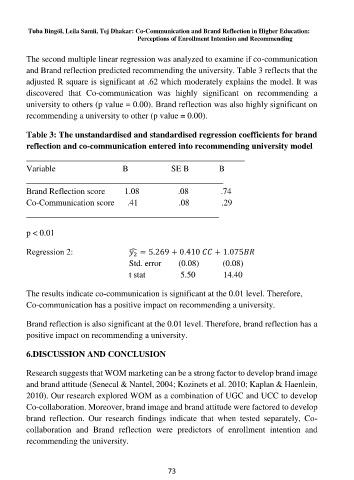
                    The second multiple linear regression was analyzed to examine if co-communication
                    and Brand reflection predicted recommending the university. Table 3 reflects that the
                    adjusted R square is significant at .62 which moderately explains the model. It was
                    discovered  that  Co-communication  was  highly  significant  on  recommending  a
                    university to others (p value = 0.00). Brand reflection was also highly significant on
                    recommending a university to other (p value = 0.00).

                    Table 3: The unstandardised and standardised regression coefficients for brand
                    reflection and co-communication entered into recommending university model
                    ___________________________________________________
                    Variable                           B                    SE B              B
                    ______________________________________________
                    Brand Reflection score         1.08                  .08               .74
                    Co-Communication score      .41                   .08               .29
                    _____________________________________________

                    p < 0.01

                    Regression 2:                  ̂ = 5.269 + 0.410      + 1.075
                                                  2
                                                 Std. error        (0.08)           (0.08)
                                                 t stat        5.50           14.40

                    The results indicate co-communication is significant at the 0.01 level. Therefore,
                    Co-communication has a positive impact on recommending a university.

                    Brand reflection is also significant at the 0.01 level. Therefore, brand reflection has a
                    positive impact on recommending a university.

                    6.DISCUSSION AND CONCLUSION

                    Research suggests that WOM marketing can be a strong factor to develop brand image
                    and brand attitude (Senecal & Nantel, 2004; Kozinets et al. 2010; Kaplan & Haenlein,
                    2010). Our research explored WOM as a combination of UGC and UCC to develop
                    Co-collaboration. Moreover, brand image and brand attitude were factored to develop
                    brand  reflection.  Our  research  findings  indicate  that  when  tested  separately,  Co-
                    collaboration  and  Brand  reflection  were  predictors  of  enrollment  intention  and
                    recommending the university.


                                                           73

