


Page 62 - Azerbaijan State University of Economics
P. 62
THE                     JOURNAL OF ECONOMIC SCIENCES: THEORY AND PRACTICE, V.80, # 1, 2023, pp. 54-66

                    Data in the study were obtained from State Statistics Committee of the Republic of
                    Azerbaijan.  The  study  covers  the  period  of  2010-2020.  Investments  in  transport
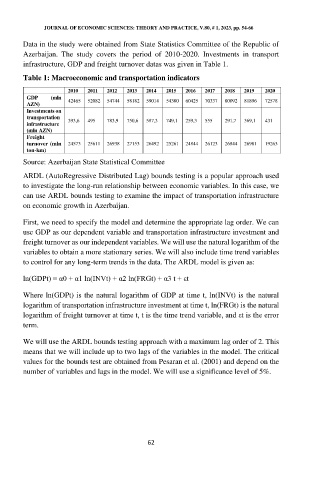
                    infrastructure, GDP and freight turnover datas was given in Table 1.

                    Table 1: Macroeconomic and transportation indicators
                                  2010   2011   2012   2013   2014   2015   2016   2017   2018   2019   2020
                     GDP     (mln   42465   52082   54744   58182   59014   54380   60425   70337   80092   81896   72578
                     AZN)
                     Investments on
                     transportation
                     infrastructure   393,6   495   783,9   750,6   587,3   749,1   259,3   555   291,7   369,1   431
                     (mln AZN)
                     Freight
                     turnover (mln   24573   25611   26938   27153   26492   25261   24844   26123   26844   26981   19263
                     ton-km)
                    Source: Azerbaijan State Statistical Committee

                    ARDL (AutoRegressive Distributed Lag) bounds testing is a popular approach used
                    to investigate the long-run relationship between economic variables. In this case, we
                    can use ARDL bounds testing to examine the impact of transportation infrastructure
                    on economic growth in Azerbaijan.

                    First, we need to specify the model and determine the appropriate lag order. We can
                    use GDP as our dependent variable and transportation infrastructure investment and
                    freight turnover as our independent variables. We will use the natural logarithm of the
                    variables to obtain a more stationary series. We will also include time trend variables
                    to control for any long-term trends in the data. The ARDL model is given as:

                    ln(GDPt) = α0 + α1 ln(INVt) + α2 ln(FRGt) + α3 t + εt

                    Where ln(GDPt) is the natural logarithm of GDP at time t, ln(INVt) is the natural
                    logarithm of transportation infrastructure investment at time t, ln(FRGt) is the natural
                    logarithm of freight turnover at time t, t is the time trend variable, and εt is the error
                    term.

                    We will use the ARDL bounds testing approach with a maximum lag order of 2. This
                    means that we will include up to two lags of the variables in the model. The critical
                    values for the bounds test are obtained from Pesaran et al. (2001) and depend on the
                    number of variables and lags in the model. We will use a significance level of 5%.


                                                           62

