


Page 133 - Azerbaijan State University of Economics
P. 133
THE                      JOURNAL OF ECONOMIC SCIENCES: THEORY AND PRACTICE, V.81, # 2, 2024, pp. 117-142

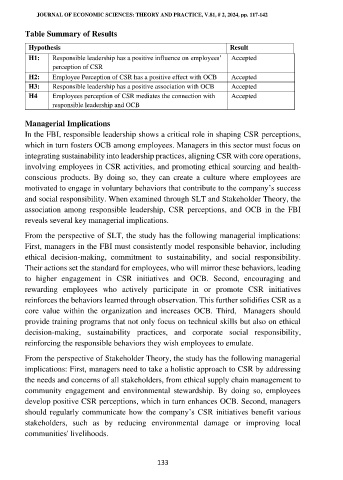
                    Table Summary of Results

                     Hypothesis                                                 Result
                     H1:    Responsible leadership has a positive influence on employees’   Accepted
                            perception of CSR
                     H2:    Employee Perception of CSR has a positive effect with OCB   Accepted
                     H3:    Responsible leadership has a positive association with OCB   Accepted
                     H4     Employees perception of CSR mediates the connection with   Accepted
                            responsible leadership and OCB


                    Managerial Implications
                    In the FBI, responsible leadership shows a critical role in shaping CSR perceptions,
                    which in turn fosters OCB among employees. Managers in this sector must focus on
                    integrating sustainability into leadership practices, aligning CSR with core operations,
                    involving employees in CSR activities, and promoting ethical sourcing and health-
                    conscious  products.  By  doing  so,  they  can  create  a  culture  where  employees  are
                    motivated to engage in voluntary behaviors that contribute to the company’s success
                    and social responsibility. When examined through SLT and Stakeholder Theory, the
                    association  among  responsible  leadership,  CSR  perceptions,  and  OCB  in  the  FBI
                    reveals several key managerial implications.

                    From the perspective of SLT, the study has the following managerial implications:
                    First, managers in the FBI must consistently model responsible behavior, including
                    ethical  decision-making,  commitment  to  sustainability,  and  social  responsibility.
                    Their actions set the standard for employees, who will mirror these behaviors, leading
                    to  higher  engagement  in  CSR  initiatives  and  OCB.  Second,  encouraging  and
                    rewarding  employees  who  actively  participate  in  or  promote  CSR  initiatives
                    reinforces the behaviors learned through observation. This further solidifies CSR as a
                    core  value  within  the  organization  and  increases  OCB.  Third,    Managers  should
                    provide training programs that not only focus on technical skills but also on ethical
                    decision-making,  sustainability  practices,  and  corporate  social  responsibility,
                    reinforcing the responsible behaviors they wish employees to emulate.

                    From the perspective of Stakeholder Theory, the study has the following managerial
                    implications: First, managers need to take a holistic approach to CSR by addressing
                    the needs and concerns of all stakeholders, from ethical supply chain management to
                    community  engagement  and  environmental  stewardship.  By  doing  so,  employees
                    develop positive CSR perceptions, which in turn enhances OCB. Second, managers
                    should regularly communicate how the company’s CSR initiatives benefit various
                    stakeholders,  such  as  by  reducing  environmental  damage  or  improving  local
                    communities' livelihoods.


                                                           133

