


Page 42 - Azerbaijan State University of Economics
P. 42
THE                      JOURNAL OF ECONOMIC SCIENCES: THEORY AND PRACTICE, V.82, # 2, 2025, pp. 32-60

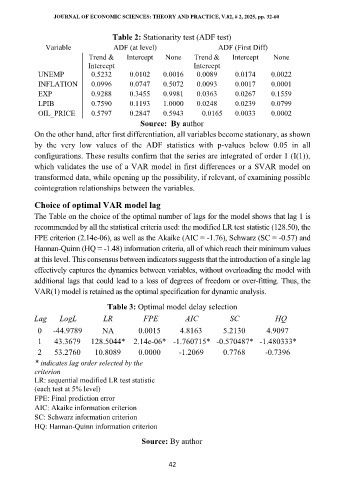
                                           Table 2: Stationarity test (ADF test)
                       Variable            ADF (at level)                 ADF (First Diff)
                                    Trend &    Intercept   None    Trend &    Intercept   None
                                    Intercept                      Intercept
                     UNEMP           0.5232     0.0102    0.0016    0.0089     0.0174     0.0022
                     INFLATION       0.0996     0.0747    0.5072    0.0093     0.0017     0.0001
                     EXP             0.9288     0.3455    0.9981    0.0363     0.0267     0.1559
                     LPIB            0.7590     0.1193    1.0000    0.0248     0.0239     0.0799
                     OIL_PRICE       0.5797     0.2847    0.5943     0.0165    0.0033     0.0002
                                                   Source:  By author
                    On the other hand, after first differentiation, all variables become stationary, as shown
                    by  the  very  low  values  of  the  ADF  statistics  with  p-values  below  0.05  in  all
                    configurations. These results confirm that the series are integrated of order 1 (I(1)),
                    which validates the use of a VAR model in first differences or a SVAR model on
                    transformed data, while opening up the possibility, if relevant, of examining possible
                    cointegration relationships between the variables.

                    Choice of optimal VAR model lag

                    The Table on the choice of the optimal number of lags for the model shows that lag 1 is
                    recommended by all the statistical criteria used: the modified LR test statistic (128.50), the
                    FPE criterion (2.14e-06), as well as the Akaike (AIC = -1.76), Schwarz (SC = -0.57) and
                    Hannan-Quinn (HQ = -1.48) information criteria, all of which reach their minimum values
                    at this level. This consensus between indicators suggests that the introduction of a single lag
                    effectively captures the dynamics between variables, without overloading the model with
                    additional lags that could lead to a loss of degrees of freedom or over-fitting. Thus, the
                    VAR(1) model is retained as the optimal specification for dynamic analysis.

                                         Table 3: Optimal model delay selection
                    Lag    LogL         LR          FPE         AIC           SC           HQ

                     0   -44.9789       NA        0.0015       4.8163       5.2130      4.9097
                     1    43.3679   128.5044*   2.14e-06*   -1.760715*   -0.570487*   -1.480333*
                     2    53.2760     10.8089     0.0000      -1.2069       0.7768      -0.7396
                    * indicates lag order selected by the
                    criterion
                    LR: sequential modified LR test statistic
                    (each test at 5% level)
                    FPE: Final prediction error
                    AIC: Akaike information criterion
                    SC: Schwarz information criterion
                    HQ: Hannan-Quinn information criterion

                                                   Source: By author


                                                           42

