


Page 44 - Azerbaijan State University of Economics
P. 44
THE                      JOURNAL OF ECONOMIC SCIENCES: THEORY AND PRACTICE, V.82, # 2, 2025, pp. 32-60

                    on reducing unemployment, which is economically plausible in the Algerian context
                    where sustained economic activity can rapidly influence demand for labor.

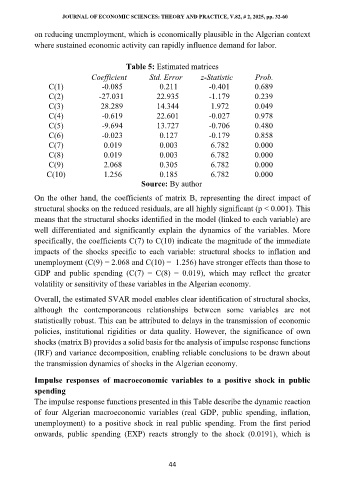
                                               Table 5: Estimated matrices
                                     Coefficient      Std. Error     z-Statistic     Prob.
                        C(1)            -0.085           0.211         -0.401        0.689
                        C(2)           -27.031          22.935         -1.179        0.239
                        C(3)           28.289           14.344          1.972        0.049
                        C(4)            -0.619          22.601         -0.027        0.978
                        C(5)            -9.694          13.727         -0.706        0.480
                        C(6)            -0.023           0.127         -0.179        0.858
                        C(7)            0.019            0.003          6.782        0.000
                        C(8)            0.019            0.003          6.782        0.000
                        C(9)            2.068            0.305          6.782        0.000
                       C(10)            1.256            0.185          6.782        0.000
                                                   Source: By author
                    On the other hand, the coefficients of matrix B, representing the direct  impact of
                    structural shocks on the reduced residuals, are all highly significant (p < 0.001). This
                    means that the structural shocks identified in the model (linked to each variable) are
                    well  differentiated  and  significantly  explain  the  dynamics  of  the  variables.  More
                    specifically, the coefficients C(7) to C(10) indicate the magnitude of the immediate
                    impacts  of the shocks  specific to  each variable: structural  shocks to  inflation  and
                    unemployment (C(9) = 2.068 and C(10) =  1.256) have stronger effects than those to
                    GDP  and  public  spending  (C(7)  =  C(8)  =  0.019),  which  may  reflect  the  greater
                    volatility or sensitivity of these variables in the Algerian economy.

                    Overall, the estimated SVAR model enables clear identification of structural shocks,
                    although  the  contemporaneous  relationships  between  some  variables  are  not
                    statistically robust. This can be attributed to delays in the transmission of economic
                    policies,  institutional  rigidities  or  data  quality.  However,  the  significance  of  own
                    shocks (matrix B) provides a solid basis for the analysis of impulse response functions
                    (IRF) and variance decomposition, enabling reliable conclusions to be drawn about
                    the transmission dynamics of shocks in the Algerian economy.

                    Impulse  responses  of  macroeconomic  variables  to  a  positive  shock  in  public
                    spending
                    The impulse response functions presented in this Table describe the dynamic reaction
                    of  four  Algerian  macroeconomic  variables  (real  GDP,  public  spending,  inflation,
                    unemployment) to  a positive shock in  real  public spending.  From the  first  period
                    onwards,  public  spending  (EXP)  reacts  strongly  to  the  shock  (0.0191),  which  is


                                                           44

