


Page 49 - Azerbaijan State University of Economics
P. 49
Fatih Chellai: Regime-Dependent Effects of Public Spending in Algeria: A Structural VAR and
                                                           Markov-Switching Approach


                    Furthermore, the cumulative test for lags 1 to 2 confirms this conclusion with a p-
                    value  of  0.4552.  These  results  suggest  that  the  VAR  model's  residuals  are  well
                    behaved  and  that  the  model's  dynamics  are  correctly  specified,  reinforcing  the
                    reliability of the resulting estimates and analyses.

                    Normality test
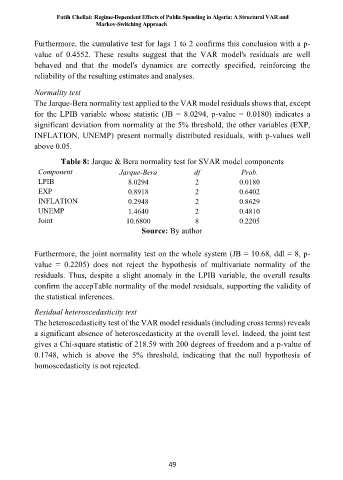
                    The Jarque-Bera normality test applied to the VAR model residuals shows that, except
                    for the LPIB variable whose statistic (JB = 8.0294, p-value = 0.0180) indicates a
                    significant deviation from normality at the 5% threshold, the other variables (EXP,
                    INFLATION, UNEMP) present normally distributed residuals, with p-values well
                    above 0.05.

                            Table 8: Jarque & Bera normality test for SVAR model components
                     Component               Jarque-Bera           df            Prob.
                     LPIB                      8.0294              2            0.0180
                     EXP                       0.8918              2            0.6402
                     INFLATION                 0.2948              2            0.8629
                     UNEMP                     1.4640              2            0.4810
                     Joint                     10.6800             8            0.2205
                                                   Source: By author


                    Furthermore, the joint normality test on the whole system (JB = 10.68, ddl = 8, p-
                    value  =  0.2205)  does  not  reject  the  hypothesis  of  multivariate  normality  of  the
                    residuals.  Thus, despite  a slight  anomaly in  the LPIB variable, the overall results
                    confirm the accepTable normality of the model residuals, supporting the validity of
                    the statistical inferences.

                    Residual heteroscedasticity test
                    The heteroscedasticity test of the VAR model residuals (including cross terms) reveals
                    a significant absence of heteroscedasticity at the overall level. Indeed, the joint test
                    gives a Chi-square statistic of 218.59 with 200 degrees of freedom and a p-value of
                    0.1748,  which  is  above  the  5%  threshold,  indicating  that  the  null  hypothesis  of
                    homoscedasticity is not rejected.


                                                           49

