


Page 51 - Azerbaijan State University of Economics
P. 51
Fatih Chellai: Regime-Dependent Effects of Public Spending in Algeria: A Structural VAR and
                                                          Markov-Switching Approach


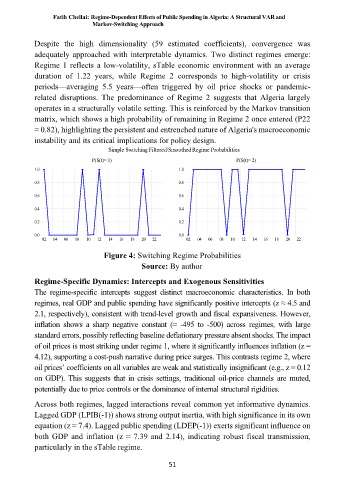
                    Despite  the  high  dimensionality  (59  estimated  coefficients),  convergence  was
                    adequately approached with interpretable dynamics. Two distinct regimes emerge:
                    Regime 1 reflects  a low-volatility, sTable economic environment with an average
                    duration  of  1.22  years,  while  Regime  2  corresponds  to  high-volatility  or  crisis
                    periods—averaging  5.5  years—often  triggered  by  oil  price  shocks  or  pandemic-
                    related  disruptions.  The  predominance  of  Regime  2  suggests  that  Algeria  largely
                    operates in a structurally volatile setting. This is reinforced by the Markov transition
                    matrix, which shows a high probability of remaining in Regime 2 once entered (P22
                    ≈ 0.82), highlighting the persistent and entrenched nature of Algeria's macroeconomic
                    instability and its critical implications for policy design.
                                          Simple Switching Filtered/Smoothed Regime Probabilities
                                     P(S(t)= 1)                                P(S(t)= 2)
                    1.0                                       1.0

                    0.8                                       0.8
                    0.6                                       0.6
                    0.4                                       0.4

                    0.2                                       0.2
                    0.0                                       0.0
                      02  04  06  08  10  12  14  16  18  20  22  02  04  06  08  10  12  14  16  18  20  22

                                        Figure 4: Switching Regime Probabilities
                                                   Source: By author

                    Regime-Specific Dynamics: Intercepts and Exogenous Sensitivities
                    The  regime-specific  intercepts  suggest  distinct  macroeconomic  characteristics.  In  both
                    regimes, real GDP and public spending have significantly positive intercepts (z ≈ 4.5 and
                    2.1, respectively), consistent with trend-level growth and fiscal expansiveness. However,
                    inflation  shows  a  sharp  negative  constant  (≈  -495  to  -500)  across  regimes,  with  large
                    standard errors, possibly reflecting baseline deflationary pressure absent shocks. The impact
                    of oil prices is most striking under regime 1, where it significantly influences inflation (z =
                    4.12), supporting a cost-push narrative during price surges. This contrasts regime 2, where
                    oil prices’ coefficients on all variables are weak and statistically insignificant (e.g., z = 0.12
                    on GDP). This suggests  that in crisis  settings,  traditional  oil-price  channels  are muted,
                    potentially due to price controls or the dominance of internal structural rigidities.

                    Across both regimes, lagged interactions reveal common yet informative dynamics.
                    Lagged GDP (LPIB(-1)) shows strong output inertia, with high significance in its own
                    equation (z ≈ 7.4). Lagged public spending (LDEP(-1)) exerts significant influence on
                    both GDP and inflation (z ≈ 7.39 and 2.14), indicating robust fiscal transmission,
                    particularly in the sTable regime.


                                                           51

