


Page 47 - Azerbaijan State University of Economics
P. 47
Fatih Chellai: Regime-Dependent Effects of Public Spending in Algeria: A Structural VAR and
                                                           Markov-Switching Approach


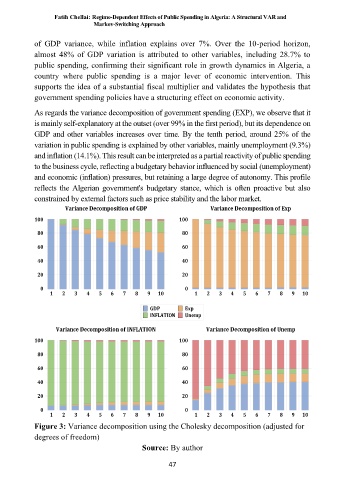
                    of  GDP  variance,  while  inflation  explains  over  7%.  Over  the  10-period  horizon,
                    almost  48% of GDP variation  is  attributed to  other variables, including  28.7% to
                    public spending, confirming their significant role in growth dynamics in Algeria, a
                    country  where  public  spending  is  a  major  lever  of  economic  intervention.  This
                    supports the idea of a substantial fiscal multiplier and validates the hypothesis that
                    government spending policies have a structuring effect on economic activity.

                    As regards the variance decomposition of government spending (EXP), we observe that it
                    is mainly self-explanatory at the outset (over 99% in the first period), but its dependence on
                    GDP and other variables increases over time. By the tenth period, around 25% of the
                    variation in public spending is explained by other variables, mainly unemployment (9.3%)
                    and inflation (14.1%). This result can be interpreted as a partial reactivity of public spending
                    to the business cycle, reflecting a budgetary behavior influenced by social (unemployment)
                    and economic (inflation) pressures, but retaining a large degree of autonomy. This profile
                    reflects the Algerian government's budgetary stance, which is often proactive but also
                    constrained by external factors such as price stability and the labor market.
                             Variance Decomposition of GDP              Variance Decomposition of Exp
                    100                                        100

                     80                                        80
                     60                                        60

                     40                                        40
                     20                                        20

                     0                                          0
                        1   2   3  4   5  6   7   8  9  10         1   2  3   4  5   6   7  8   9  10

                                                      GDP       Exp
                                                      INFLATION  Unemp
                          Variance Decomposition of INFLATION          Variance Decomposition of Unemp

                    100                                        100
                     80                                        80

                     60                                        60
                     40                                        40

                     20                                        20

                     0                                          0
                        1   2     3     4  5  6  7  8  9  10       1   2  3   4  5   6   7  8   9  10
                    Figure 3: Variance decomposition using the Cholesky decomposition (adjusted for
                    degrees of freedom)
                                                    Source: By author


                                                           47

