


Page 48 - Azerbaijan State University of Economics
P. 48
THE                      JOURNAL OF ECONOMIC SCIENCES: THEORY AND PRACTICE, V.82, # 2, 2025, pp. 32-60

                    For the INFLATION variable, the variance decomposition shows strong self-explanation
                    from the outset (94% in period 1), but this share slowly declines to around 86.7% in period
                    10,  indicating  structural  stability  of  inflation.  However,  the  growing  impact  of  public
                    spending (4.5% in period 10) on inflation is indicative of a demand effect, probably due to
                    the  injection  of  liquidity  via  fiscal  policies.  The  marginal  but  nonnegligible  role  of
                    unemployment  (1.8%  in  period  10)  suggests  low  price-employment  sensitivity  in  the
                    Algerian context, which could be explained by the duality of the labor market and price
                    regulation through subsidies or administrative control.

                    Finally, decomposing the variance of the unemployment rate reveals a dynamic strongly
                    influenced by the other variables. While more than 84% of unemployment is initially
                    explained by its own shocks, this share falls to 41% in period 10. Real GDP becomes the
                    major source of variation in unemployment (nearly 40% in period 10), confirming a robust
                    inverse relationship between economic activity and employment, in line with Okun's law.
                    Public spending, meanwhile, explains around 12.4% of the variance in unemployment over
                    the long horizon, confirming its employment-supporting effect, albeit limited over time.
                    These results highlight the structural dependence of the Algerian labor market on economic
                    growth  and  fiscal  policies,  in  a  context  where  structural  reforms  remain  insufficiently
                    entrenched.

                    Validation of the estimated SVAR(1) model
                    This subsection presents the validation of the SVAR(1) model to ensure its statistical
                    soundness and reliability. We assess the model through key diagnostic tests, including
                    residual  autocorrelation,  stability,  and  normality  checks.  These  validations  are
                    essential before interpreting structural shocks and impulse response functions.

                    Residual auto-correlation test
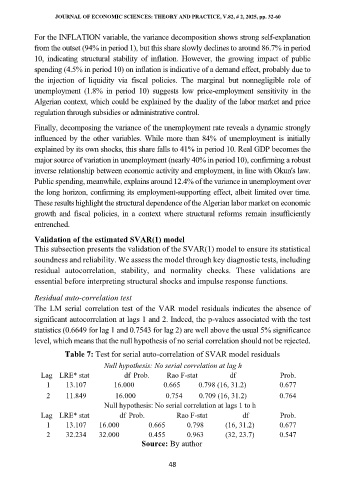
                    The LM serial  correlation test  of the  VAR model residuals indicates  the  absence  of
                    significant autocorrelation at lags 1 and 2. Indeed, the p-values associated with the test
                    statistics (0.6649 for lag 1 and 0.7543 for lag 2) are well above the usual 5% significance
                    level, which means that the null hypothesis of no serial correlation should not be rejected.

                             Table 7: Test for serial auto-correlation of SVAR model residuals
                                        Null hypothesis: No serial correlation at lag h
                      Lag  LRE* stat          df  Prob.    Rao F-stat        df             Prob.
                       1     13.107        16.000         0.665     0.798 (16, 31.2)        0.677
                       2     11.849         16.000          0.754     0.709 (16, 31.2)      0.764
                                        Null hypothesis: No serial correlation at lags 1 to h
                      Lag  LRE* stat         df  Prob.        Rao F-stat         df         Prob.
                       1     13.107    16.000        0.665       0.798      (16, 31.2)      0.677
                       2     32.234    32.000        0.455       0.963      (32, 23.7)      0.547
                                                   Source: By author


                                                           48

