


Page 87 - Azerbaijan State University of Economics
P. 87
THE                      JOURNAL OF ECONOMIC SCIENCES: THEORY AND PRACTICE, V.82, # 2, 2025, pp. 79-95

                    Table 4 presents the results of the factor analysis, based on the eigenvalues derived
                    from the eigenvalue matrix. The percentage of variance explained refers to the extent
                    to  which  a  specific  variable  accounts  for  variance  in  relation  to  all  variables.  To
                    describe a phenomenon effectively, all its aspects must be taken into consideration.
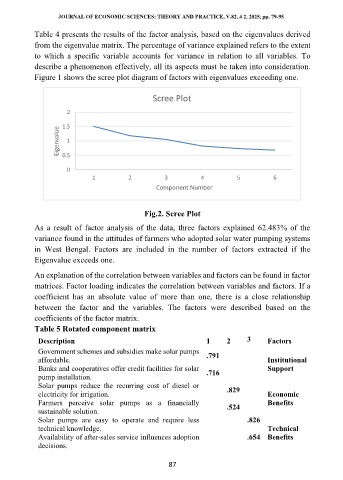
                    Figure 1 shows the scree plot diagram of factors with eigenvalues exceeding one.


                                                       Scree Plot

                             2
                            1.5
                           Eigenvalue  0.5 1


                             0
                                     1          2         3          4          5         6
                                                        Component Number


                                                    Fig.2. Scree Plot

                    As a result of  factor analysis  of the data, three factors explained 62.483% of the
                    variance found in the attitudes of farmers who adopted solar water pumping systems
                    in  West  Bengal.  Factors  are  included  in  the  number  of  factors  extracted  if  the
                    Eigenvalue exceeds one.

                    An explanation of the correlation between variables and factors can be found in factor
                    matrices. Factor loading indicates the correlation between variables and factors. If a
                    coefficient  has  an  absolute  value  of  more  than  one,  there  is  a  close  relationship
                    between  the  factor  and  the  variables.  The  factors  were  described  based  on  the
                    coefficients of the factor matrix.
                    Table 5 Rotated component matrix

                     Description                                       1     2     3     Factors
                     Government schemes and subsidies make solar pumps   .791
                     affordable.                                                         Institutional
                     Banks and cooperatives offer credit facilities for solar            Support
                     pump installation.                                .716
                     Solar  pumps  reduce  the  recurring  cost  of  diesel  or      .829
                     electricity for irrigation.                                         Economic
                     Farmers  perceive  solar  pumps  as  a  financially      .524       Benefits
                     sustainable solution.
                     Solar  pumps  are  easy  to  operate  and  require  less      .826
                     technical knowledge.                                                Technical
                     Availability of after-sales service influences adoption         .654   Benefits
                     decisions.


                                                           87

