


Page 44 - Azerbaijan State University of Economics
P. 44
THE                      JOURNAL OF ECONOMIC SCIENCES: THEORY AND PRACTICE, V.83, # 1, 2026, pp. 40-57

                    enhance  operational  efficiency  and  decision-making,  enabling  dynamic  logistics
                    adjustments and improved risk management (Daios & Stefanou, 2025). Particularly
                    post-pandemic,  many  multinational  corporations  increasingly  favor  establishing
                    multi-hub  or  regional  value  chain  layouts  to  enhance  resilience  and  navigate
                    globalization uncertainties.

                    These transformations are steering global value chains toward greater digitalization,
                    intelligence, and decentralization. Conversely, in international trade, the proportion of
                    high-value-added  exports  driven  by  AI  adoption  rates  further  reshapes  positions
                    within global value chains.

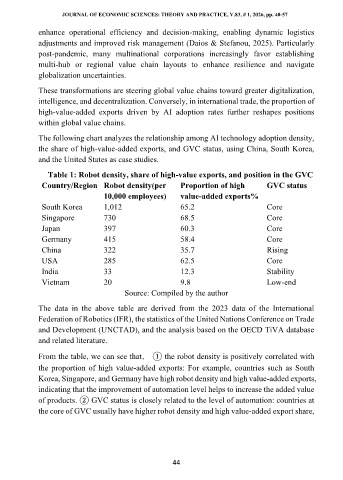
                    The following chart analyzes the relationship among AI technology adoption density,
                    the share of high-value-added exports, and GVC status, using China, South Korea,
                    and the United States as case studies.

                       Table 1: Robot density, share of high-value exports, and position in the GVC
                     Country/Region  Robot density(per        Proportion of high       GVC status
                                       10,000 employees)      value-added exports%
                     South Korea       1,012                  65.2                     Core
                     Singapore         730                    68.5                     Core
                     Japan             397                    60.3                     Core
                     Germany           415                    58.4                     Core
                     China             322                    35.7                     Rising
                     USA               285                    62.5                     Core
                     India             33                     12.3                     Stability
                     Vietnam           20                     9.8                      Low-end
                                             Source: Compiled by the author

                    The  data  in  the  above  table  are  derived  from  the  2023  data  of  the  International
                    Federation of Robotics (IFR), the statistics of the United Nations Conference on Trade
                    and Development (UNCTAD), and the analysis based on the OECD TiVA database
                    and related literature.

                    From the table, we can see that, ① the robot density is positively correlated with
                    the proportion of high value-added exports: For example, countries such as South
                    Korea, Singapore, and Germany have high robot density and high value-added exports,
                    indicating that the improvement of automation level helps to increase the added value
                    of products. ② GVC status is closely related to the level of automation: countries at
                    the core of GVC usually have higher robot density and high value-added export share,


                                                           44

