


Page 68 - Azerbaijan State University of Economics
P. 68
THE                      JOURNAL OF ECONOMIC SCIENCES: THEORY AND PRACTICE, V.83, # 1, 2026, pp. 58-81

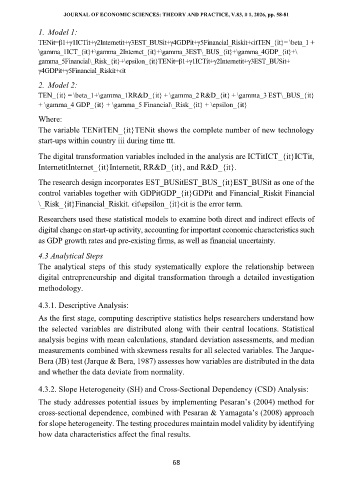
                    1.  Model 1:
                    TENit=β1+γ1ICTit+γ2Internetit+γ3EST_BUSit+γ4GDPit+γ5Financial_Riskit+ϵitTEN_{it}= \beta_1 +
                    \gamma_1ICT_{it}+\gamma_2Internet_{it}+\gamma_3EST\_BUS_{it}+\gamma_4GDP_{it}+\
                    gamma_5Financial\_Risk_{it}+\epsilon_{it}TENit=β1+γ1ICTit+γ2Internetit+γ3EST_BUSit+
                    γ4GDPit+γ5Financial_Riskit+ϵit

                    2.  Model 2:
                    TEN_{it} = \beta_1+\gamma_1RR&D_{it} + \gamma_2 R&D_{it} + \gamma_3 EST\_BUS_{it}
                    + \gamma_4 GDP_{it} + \gamma_5 Financial\_Risk_{it} + \epsilon_{it}

                    Where:
                    The variable TENitTEN_{it}TENit shows the complete number of new technology
                    start-ups within country iii during time ttt.

                    The digital transformation variables included in the analysis are ICTitICT_{it}ICTit,
                    InternetitInternet_{it}Internetit, RR&D_{it}, and R&D_{it}.

                    The research design incorporates EST_BUSitEST_BUS_{it}EST_BUSit as one of the
                    control variables together with GDPitGDP_{it}GDPit and Financial_Riskit Financial
                    \_Risk_{it}Financial_Riskit. ϵit\epsilon_{it}ϵit is the error term.

                    Researchers used these statistical models to examine both direct and indirect effects of
                    digital change on start-up activity, accounting for important economic characteristics such
                    as GDP growth rates and pre-existing firms, as well as financial uncertainty.

                    4.3 Analytical Steps
                    The  analytical  steps  of  this  study  systematically  explore  the  relationship  between
                    digital entrepreneurship and digital transformation through a detailed investigation
                    methodology.

                    4.3.1. Descriptive Analysis:

                    As the first stage, computing descriptive statistics helps researchers understand how
                    the  selected  variables  are  distributed  along  with  their  central  locations.  Statistical
                    analysis begins with mean calculations, standard deviation assessments, and median
                    measurements combined with skewness results for all selected variables. The Jarque-
                    Bera (JB) test (Jarque & Bera, 1987) assesses how variables are distributed in the data
                    and whether the data deviate from normality.

                    4.3.2. Slope Heterogeneity (SH) and Cross-Sectional Dependency (CSD) Analysis:
                    The study addresses potential issues by implementing Pesaran’s (2004) method for
                    cross-sectional dependence, combined with Pesaran & Yamagata’s (2008) approach
                    for slope heterogeneity. The testing procedures maintain model validity by identifying
                    how data characteristics affect the final results.


                                                           68

