


Page 71 - Azerbaijan State University of Economics
P. 71
Swaty Sharma, Munish Gupta: Does the Rise of Emerging Technologies Transform Digital
                                     Entrepreneurial Activity? Evidence from OECD Nations


                    5.1 Model Analysis
                    The study uses two models to examine the impact of different variables:

                                       Table 2: Slope Heterogeneity Test Results
                        Model                    Variables                  Stat   adj Stat   Sig

                       Model -1  ICT, Internet, GDP, EST-BUS, financial Risk,   3.001   5.009   0.000
                                 TEN
                       Model -2  ICT, RR&D, R&D,  EST-BUS, financial Risk,   2.998   4.001   0.000
                                 TEN
                                                 Author’s Creation

                         Table-3: Estimated Intercepts of Key Variables at Level 0 and Level 1
                            Variables           Intercept at level 0          Intercept at level 1
                              ICT                   -1.786044                   -3.894527***
                             Internet               -2.142222                   -3.597857***
                            EST_bus                 -2.598764                   -3.897242***
                              TEN                   -2.009009                   -4.211489***
                              GDP                   -1.298765                   -2.884287***
                             RR&D                   -1.276547                   -2.898473***
                          Financial Risk              -1.654                      -3.789***
                              R&D                   -1.049555                   -3.890233***
                                                 Author’s Creation

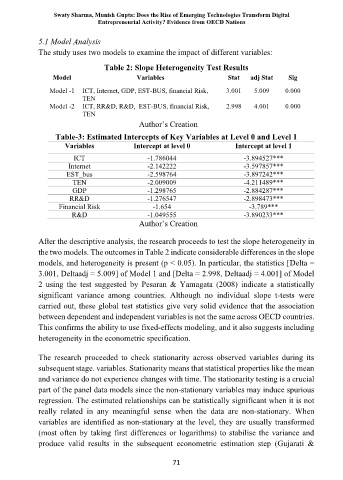
                    After the descriptive analysis, the research proceeds to test the slope heterogeneity in
                    the two models. The outcomes in Table 2 indicate considerable differences in the slope
                    models, and heterogeneity is present (p < 0.05). In particular, the statistics [Delta =
                    3.001, Deltaadj = 5.009] of Model 1 and [Delta = 2.998, Deltaadj = 4.001] of Model
                    2  using  the  test  suggested  by  Pesaran  &  Yamagata  (2008)  indicate  a  statistically
                    significant  variance  among  countries.  Although  no  individual  slope  t-tests  were
                    carried out, these global test statistics give very solid evidence that the association
                    between dependent and independent variables is not the same across OECD countries.
                    This confirms the ability to use fixed-effects modeling, and it also suggests including
                    heterogeneity in the econometric specification.


                    The  research  proceeded  to  check  stationarity  across  observed  variables  during  its
                    subsequent stage. variables. Stationarity means that statistical properties like the mean
                    and variance do not experience changes with time. The stationarity testing is a crucial
                    part of the panel data models since the non-stationary variables may induce spurious
                    regression. The estimated relationships can be statistically significant when it is not
                    really  related  in  any  meaningful  sense  when  the  data  are  non-stationary.  When
                    variables are identified as non-stationary at the level, they are usually transformed
                    (most often by taking first differences or logarithms) to stabilise the variance and
                    produce  valid  results  in  the  subsequent  econometric  estimation  step  (Gujarati  &


                                                           71

