


Page 131 - Azerbaijan State University of Economics
P. 131
THE JOURNAL OF ECONOMIC SCIENCES: THEORY AND PRACTICE


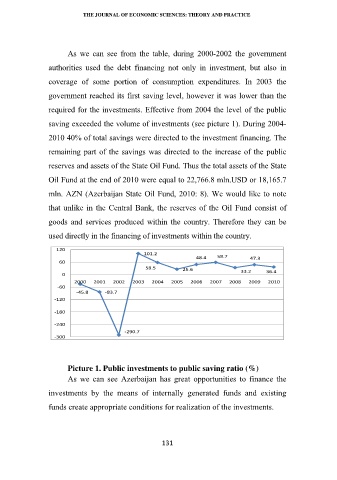
                     As we can see from the table, during 2000-2002  the government

               authorities used the debt financing not only in investment, but also in
               coverage of some portion of consumption expenditures. In 2003 the

               government reached its first saving level, however it was lower than the
               required for the investments. Effective from 2004 the level of the public

               saving exceeded the volume of investments (see picture 1). During 2004-

               2010 40% of total savings were directed to the investment financing. The
               remaining part of the savings was directed to the increase of the public

               reserves and assets of the State Oil Fund. Thus the total assets of the State
               Oil Fund at the end of 2010 were equal to 22,766.8 mln.USD or 18,165.7

               mln. AZN (Azerbaijan State Oil Fund, 2010: 8). We would like to note

               that unlike in the Central Bank, the reserves of the Oil Fund consist of
               goods and services produced within the country. Therefore they can be

               used directly in the financing of investments within the country.

                  120
                                            101.2
                                                           48.4  58.7      47.3
                   60
                                            58.5       25.6
                   0                                                    33.2    36.4
                       2000  2001  2002  2003  2004  2005  2006  2007  2008  2009  2010
                  ‐60
                        ‐45.8   ‐83.7
                 ‐120
                 ‐180

                 ‐240
                                      ‐290.7
                 ‐300


                     Picture 1. Public investments to public saving ratio (%)
                     As we can see Azerbaijan has great opportunities to finance the

               investments by the means of internally generated funds and existing
               funds create appropriate conditions for realization of the investments.


                                                 131

