


Page 27 - Azerbaijan State University of Economics
P. 27
THE              Luan Vardari, Kiran Sood: Sate-Dependent Transmission of Oil and Electricity Shocks to
                           Equity Markets: Evidence from Emerging and Transitional Economies


                    To make the time series stationary, all the time series were converted into logarithmic
                    returns. Unit root tests ADF, PP and KPSS established that the level variables are I(1)
                    and the series of returns are I(0) which are stationary. Descriptive statistics indicated
                    that there were significant non-normality and excess kurtosis so nonlinear models and
                    regime-switching estimation procedures could be used.

                    3.2 Methodological Framework
                    The methodological approach builds on the nonlinear modeling structures developed
                    by  Bildirici  and  Badur  (2019)  and  Raifu  and  Oshota  (2023).  In  this  study,  these
                    frameworks are integrated to form a unified empirical design that combines the Panel
                    Markov-Switching  Vector  Autoregressive  (MS-VARX)  model,  Markov-Switching
                    Granger Causality, Dynamic Conditional Correlation GARCH (DCC-GARCH), and
                    copula-based dependence models. In this way, from this comprehensive framework,
                    a detailed examination of the links between these energy and financial factors is made,
                    which takes into account both structural modifications and nonlinear relationships that
                    are considered to vary on a market basis.

                    (a) Panel Markov Switching VARX
                    In order to account for potential regime transitions that are not immediately apparent,
                    the  baseline  specification  attempts  to  capture  the  changing  relationships  between
                    financial  and  energy  indicators.  The  MS-VARX  framework  makes  it  feasible  to
                    analyze how the strength and direction of relationships among variables change over
                    time, as  well as  to  identify discrete market  phases,  such as times of stability  and
                    volatility.


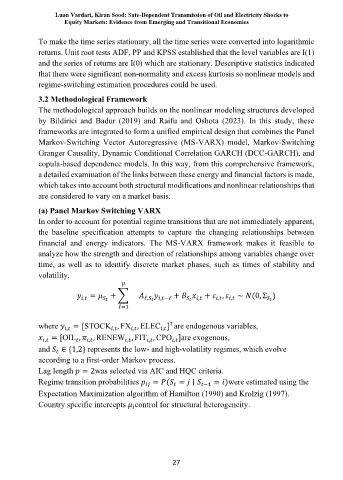
                                    ,    =    + ∑     ℓ,        ,  −ℓ  +        +    ,      ,    ∼   (0, Σ )
                                                                          ,
                                                                       ,


                                           ℓ=1

                                                           ⊤
                    where      ,    = [STOCK , FX , ELEC ] are endogenous variables,
                                           ,
                                                 ,
                                                          ,
                         ,    = [OIL ,    , RENEW , FIT , CPO ]are exogenous,
                                               ,
                                                             ,
                                    ,

                                                      ,
                    and    ∈ {1,2} represents the low- and high-volatility regimes, which evolve

                    according to a first-order Markov process.
                    Lag length    = 2was selected via AIC and HQC criteria.
                    Regime transition probabilities    =   (   =    ∣      −1  =   )were estimated using the


                    Expectation Maximization algorithm of Hamilton (1990) and Krolzig (1997).
                    Country specific intercepts    control for structural heterogeneity.


                                                           27

