


Page 30 - Azerbaijan State University of Economics
P. 30
THE                      JOURNAL OF ECONOMIC SCIENCES: THEORY AND PRACTICE, V.83, # 1, 2026, pp. 20-39

                              Table 1: Unit Root and Johansen Cointegration Test Results
                                                                      Trace
                            ADF    ADF 1st   PP    PP 1st                      Max Eigen
                    Variable                                Integration Stat             Cointegration
                            Level  Diff.     Level  Diff.                      Stat (r≤1)
                                                                      (r=0)
                    STOCK  −1.45  −6.88***  −1.38  −6.91***  I(1)     14.21    6.73      None
                    OIL     −2.11  −8.27***  −1.98  −8.19***  I(1)    18.02    7.64      None
                    ELEC    −1.64  −7.34***  −1.57  −7.28***  I(1)    16.54    5.12      None
                    FX      −1.83  −6.75***  −1.69  −6.70***  I(1)    13.93    5.21      None
                    RENEW  −1.02  −5.88***  −0.97  −5.83***  I(1)     11.80    4.36      None
                    Notes: ADF = Augmented Dickey Fuller; PP = Phillips Perron. *** p < 0.01.

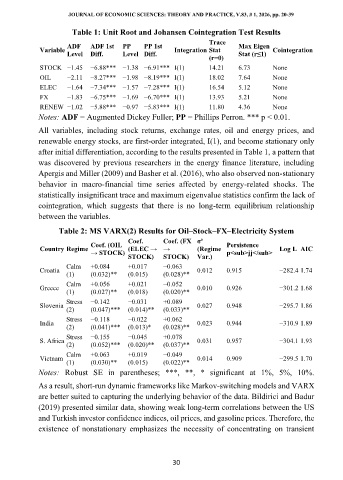
                    All  variables,  including  stock  returns,  exchange  rates,  oil  and  energy  prices,  and
                    renewable energy stocks, are first-order integrated, I(1), and become stationary only
                    after initial differentiation, according to the results presented in Table 1, a pattern that
                    was discovered by previous researchers in the energy finance literature, including
                    Apergis and Miller (2009) and Basher et al. (2016), who also observed non-stationary
                    behavior  in  macro-financial  time  series  affected  by  energy-related  shocks.  The
                    statistically insignificant trace and maximum eigenvalue statistics confirm the lack of
                    cointegration,  which  suggests  that  there  is  no  long-term  equilibrium  relationship
                    between the variables.

                          Table 2: MS VARX(2) Results for Oil–Stock–FX–Electricity System
                                              Coef.      Coef. (FX  σ²
                                   Coef. (OIL                              Persistence
                    Country Regime            (ELEC →  →           (Regime                 Log L  AIC
                                   → STOCK)                                p<sub>jj</sub>
                                              STOCK)     STOCK)  Var.)
                            Calm   +0.084     +0.017     −0.063
                    Croatia                                        0.012   0.915           −282.4 1.74
                            (1)    (0.032)**   (0.015)   (0.028)**
                            Calm   +0.056     +0.021     −0.052
                    Greece                                         0.010   0.926           −301.2 1.68
                            (1)    (0.027)**   (0.018)   (0.020)**
                            Stress  −0.142    −0.031     +0.089
                    Slovenia                                       0.027   0.948           −295.7 1.86
                            (2)    (0.047)***  (0.014)**   (0.033)**
                            Stress  −0.118    −0.022     +0.062
                    India                                          0.023   0.944           −310.9 1.89
                            (2)    (0.041)***  (0.013)*   (0.028)**
                            Stress  −0.155    −0.045     +0.078
                    S. Africa                                      0.031   0.957           −304.1 1.93
                            (2)    (0.052)***  (0.020)**   (0.037)**
                            Calm   +0.063     +0.019     −0.049
                    Vietnam                                        0.014   0.909           −299.5 1.70
                            (1)    (0.030)**   (0.015)   (0.022)**
                    Notes:  Robust  SE  in  parentheses;  ***,  **,  *  significant  at  1%,  5%,  10%.

                    As a result, short-run dynamic frameworks like Markov-switching models and VARX
                    are better suited to capturing the underlying behavior of the data. Bildirici and Badur
                    (2019) presented similar data, showing weak long-term correlations between the US
                    and Turkish investor confidence indices, oil prices, and gasoline prices. Therefore, the
                    existence  of  nonstationary  emphasizes  the  necessity  of  concentrating  on  transient


                                                           30

