


Page 28 - Azerbaijan State University of Economics
P. 28
THE                      JOURNAL OF ECONOMIC SCIENCES: THEORY AND PRACTICE, V.83, # 1, 2026, pp. 20-39

                    (b) Markov Switching Granger Causality (MS GC)
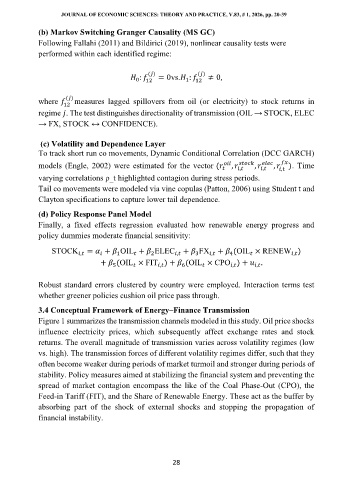
                    Following Fallahi (2011) and Bildirici (2019), nonlinear causality tests were
                    performed within each identified regime:

                                                    (  )
                                                                   (  )
                                                  :    12  = 0vs.   :    12  ≠ 0,
                                                               1
                                                 0

                            (  )
                    where     measures  lagged  spillovers  from  oil  (or  electricity)  to  stock  returns  in
                           12
                    regime   . The test distinguishes directionality of transmission (OIL → STOCK, ELEC
                    → FX, STOCK ↔ CONFIDENCE).

                     (c) Volatility and Dependence Layer
                    To track short run co movements, Dynamic Conditional Correlation (DCC GARCH)


                    models (Engle, 2002) were estimated  for the vector (             ,      ,    ,      ,    ,    ). Time
                                                                                             ,
                    varying correlations ρ_t highlighted contagion during stress periods.
                    Tail co movements were modeled via vine copulas (Patton, 2006) using Student t and
                    Clayton specifications to capture lower tail dependence.

                    (d) Policy Response Panel Model
                    Finally,  a  fixed  effects  regression  evaluated  how  renewable  energy  progress  and
                    policy dummies moderate financial sensitivity:

                        STOCK     ,    =    +    OIL +    ELEC   ,    +    FX   ,    +    (OIL × RENEW )


                                           1
                                                     2
                                                                  3
                                                                            4
                                                                                                 ,

                                      +    (OIL × FIT ) +    (OIL × CPO ) +    .
                                                              6
                                                         ,

                                                                               ,

                                          5
                                                                                      ,

                    Robust standard errors clustered by country were employed. Interaction terms test
                    whether greener policies cushion oil price pass through.

                    3.4 Conceptual Framework of Energy–Finance Transmission
                    Figure 1 summarizes the transmission channels modeled in this study. Oil price shocks
                    influence  electricity  prices,  which  subsequently  affect  exchange  rates  and  stock
                    returns. The overall magnitude of transmission varies across volatility regimes (low
                    vs. high). The transmission forces of different volatility regimes differ, such that they
                    often become weaker during periods of market turmoil and stronger during periods of
                    stability. Policy measures aimed at stabilizing the financial system and preventing the
                    spread of market contagion encompass the like of the Coal Phase-Out (CPO), the
                    Feed-in Tariff (FIT), and the Share of Renewable Energy. These act as the buffer by
                    absorbing  part  of  the  shock  of  external  shocks  and  stopping  the  propagation  of
                    financial instability.


                                                           28

