


Page 33 - Azerbaijan State University of Economics
P. 33
THE              Luan Vardari, Kiran Sood: Sate-Dependent Transmission of Oil and Electricity Shocks to
                           Equity Markets: Evidence from Emerging and Transitional Economies


                    The findings, summarized in Table 4, reveal nonlinear and regime-dependent causal
                    relationships between stock market returns, oil prices, energy prices, and exchange
                    rates,  with  only  a  few  one-way  effects  found  using  conventional  linear  Granger
                    causality tests, particularly from exchange rates to stock prices and from oil to stock
                    prices. However, more connections become apparent when the analysis is extended
                    even further using the Markov-switching Granger method, especially in situations
                    with increased volatility. For example, a bidirectional relationship between oil prices
                    and stock returns is seen during Regime 2, suggesting that during economic downturns
                    changes  in  energy  markets  can  both  cause  and  respond  to  changes  in  financial
                    performance, a result that is consistent with research by Chang and Lee (2011) and
                    Bouoiyour  et  al.  (2017),  who  found  comparable  feedback  effects  during  market
                    turbulence. Changes in portfolios by investors due to shifts in oil prices are often noted
                    as one of the contributing factors to these movements. Furthermore, the results also
                    provide evidence of a strong causal relationship between changes in exchange rates
                    and  the  stock  market  across  both  regimes,  indicating  support  for  the  “financial
                    channel” hypothesis developed by Basher and Sadorsky (2006) and reemphasized by
                    Raifu and Oshota (2023). The evidence suggests that currency depreciation typically
                    increases pressure on imported inflation, which in turn tends to lower stock values,
                    while electricity price shocks exhibit relatively weaker causal effects, suggesting that
                    the  transmission  mechanism  may  operate  more  slowly  and  vary  by  location,
                    supporting  the  claim  made  by  Apergis  and  Miller  (2009)  that  short-run  financial
                    effects can be reduced by liberalized energy markets. When considered together, these
                    results show how  cross-market  transmission effects  are amplified during times of
                    increased volatility, thus providing additional evidence in favor of the asymmetric
                    dependence hypothesis, which was first presented by Mork (1989) and then extended
                    by Bildirici and Badur (2019) using the belief-augmented MS-VAR framework.

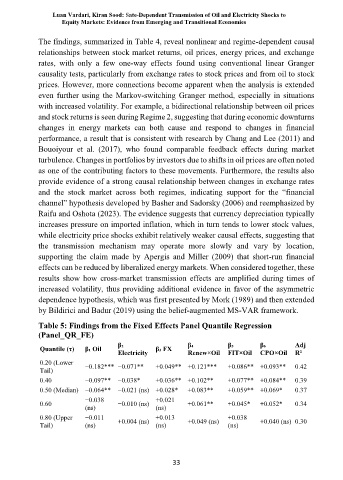
                    Table 5: Findings from the Fixed Effects Panel Quantile Regression
                    (Panel_QR_FE)
                                           β₂                   β₄          β₅       β₆         Adj
                    Quantile (τ)   β₁ Oil             β₃ FX
                                           Electricity          Renew×Oil  FIT×Oil  CPO×Oil  R²
                    0.20 (Lower   −0.182***  −0.071**   +0.049**  +0.121***   +0.086**  +0.093**   0.42
                    Tail)
                    0.40          −0.097**  −0.038*   +0.036**  +0.102**    +0.077**  +0.084**   0.39
                    0.50 (Median)  −0.064**  −0.021 (ns)  +0.028*   +0.083**   +0.059**  +0.069*   0.37
                                  −0.038              +0.021
                    0.60                   −0.010 (ns)          +0.061**    +0.045*   +0.052*   0.34
                                  (ns)                (ns)
                    0.80 (Upper   −0.011   +0.004 (ns)   +0.013   +0.049 (ns)   +0.038   +0.040 (ns)  0.30
                    Tail)         (ns)                (ns)                  (ns)


                                                           33

