


Page 29 - Azerbaijan State University of Economics
P. 29
THE              Luan Vardari, Kiran Sood: Sate-Dependent Transmission of Oil and Electricity Shocks to
                            Equity Markets: Evidence from Emerging and Transitional Economies


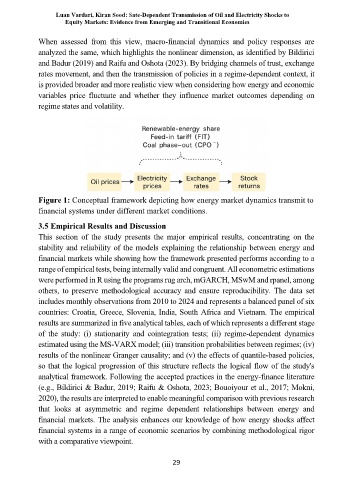
                    When  assessed  from  this  view,  macro-financial  dynamics  and  policy  responses  are
                    analyzed the same, which highlights the nonlinear dimension, as identified by Bildirici
                    and Badur (2019) and Raifu and Oshota (2023). By bridging channels of trust, exchange
                    rates movement, and then the transmission of policies in a regime-dependent context, it
                    is provided broader and more realistic view when considering how energy and economic
                    variables  price  fluctuate  and  whether  they  influence  market  outcomes  depending  on
                    regime states and volatility.


                    Figure 1: Conceptual framework depicting how energy market dynamics transmit to
                    financial systems under different market conditions.

                    3.5 Empirical Results and Discussion
                    This  section  of  the  study  presents  the  major  empirical  results,  concentrating  on  the
                    stability and reliability of the models explaining the relationship between energy and
                    financial markets while showing how the framework presented performs according to a
                    range of empirical tests, being internally valid and congruent. All econometric estimations
                    were performed in R using the programs rug arch, mGARCH, MSwM and rpanel, among
                    others, to preserve methodological accuracy  and  ensure reproducibility. The  data set
                    includes monthly observations from 2010 to 2024 and represents a balanced panel of six
                    countries: Croatia, Greece, Slovenia, India, South Africa and Vietnam. The empirical
                    results are summarized in five analytical tables, each of which represents a different stage
                    of  the  study:  (i)  stationarity  and  cointegration  tests;  (ii)  regime-dependent  dynamics
                    estimated using the MS-VARX model; (iii) transition probabilities between regimes; (iv)
                    results of the nonlinear Granger causality; and (v) the effects of quantile-based policies,
                    so that the logical progression of this structure reflects the logical flow of the study's
                    analytical framework. Following the accepted practices in the energy-finance literature
                    (e.g., Bildirici & Badur, 2019; Raifu & Oshota, 2023; Bouoiyour et al., 2017; Mokni,
                    2020), the results are interpreted to enable meaningful comparison with previous research
                    that  looks  at  asymmetric  and  regime  dependent  relationships  between  energy  and
                    financial markets. The analysis enhances our knowledge of how energy shocks affect
                    financial systems in a range of economic scenarios by combining methodological rigor
                    with a comparative viewpoint.


                                                           29

