


Page 31 - Azerbaijan State University of Economics
P. 31
THE              Luan Vardari, Kiran Sood: Sate-Dependent Transmission of Oil and Electricity Shocks to
                          Equity Markets: Evidence from Emerging and Transitional Economies


                    volatility spillovers and short-term, regime-dependent interactions rather than long-
                    term equilibrium dynamics. The analytical design of the current study is primarily
                    motivated by this consideration.

                    State-dependent asymmetries in the transmission of electricity and oil shocks to stock
                    returns  are  amply  demonstrated  by  the  Markov-Switching  VARX(2)  estimations
                    presented in Table 2. According to the estimated coefficients, changes in the price of
                    oil have a major detrimental impact on stock performance when volatility is high
                    (Regime 2), but their impact is neutral or even slightly positive when volatility is low.
                    This asymmetric pattern supports the findings of Wang et al. (2013) for both oil-
                    importing  and  oil-exporting  economies  and  Raifu  and  Oshota  (2023)  for  Nigeria,
                    demonstrating  that  the  direction  and  strength  of  energy-finance  linkages  are
                    influenced by larger macro-financial environments. The findings indicate significant
                    cross-country  variations  in  electricity  prices.  The  impact  is  usually  positive  in
                    economies that rely more on renewable energy, such as Slovenia and Greece, but tends
                    to be negative in countries that rely more heavily on fossil fuels, such as South Africa
                    and India, which supports the claims made by Le and Chang (2015) and Dhauqi et al.
                    (2018) that diversifying the energy mix can reduce the negative effects of oil-related
                    shocks. Exchange rate fluctuations seem to play a substantial role during turbulent
                    markets. The positive and significantly statistically coefficient indicates that currency
                    depreciation exacerbated stock market losses when fuel energy prices rose (Basher et
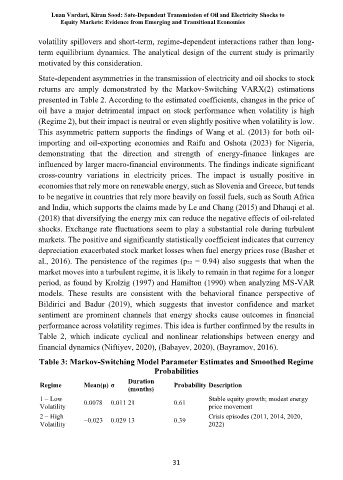
                    al., 2016). The persistence of the regimes (p₂₂ = 0.94) also suggests that when the
                    market moves into a turbulent regime, it is likely to remain in that regime for a longer
                    period, as found by Krolzig (1997) and Hamilton (1990) when analyzing MS-VAR
                    models.  These  results  are  consistent  with  the  behavioral  finance  perspective  of
                    Bildirici  and  Badur  (2019),  which  suggests  that  investor  confidence  and  market
                    sentiment are prominent channels that energy shocks  cause outcomes in  financial
                    performance across volatility regimes. This idea is further confirmed by the results in
                    Table  2,  which  indicate  cyclical  and  nonlinear  relationships  between  energy  and
                    financial dynamics (Niftiyev, 2020), (Babayev, 2020), (Bayramov, 2016).

                    Table 3: Markov-Switching Model Parameter Estimates and Smoothed Regime
                                                      Probabilities
                                              Duration
                    Regime       Mean(μ) σ                  Probability Description
                                              (months)
                    1 – Low                                           Stable equity growth; modest energy
                    Volatility   0.0078  0.011 21           0.61      price movement
                    2 – High                                          Crisis episodes (2011, 2014, 2020,
                    Volatility   −0.023  0.029 13           0.39      2022)


                                                           31

