


Page 32 - Azerbaijan State University of Economics
P. 32
THE                      JOURNAL OF ECONOMIC SCIENCES: THEORY AND PRACTICE, V.83, # 1, 2026, pp. 20-39

                    Regime 2 indicates periods of increased volatility being mostly a result of the global shocks
                    in energy and financial markets, while regime 1 indicates periods of relative market calm.
                    The estimates provided in Table 3 provide an indication of how the market fluctuated
                    randomly during the sample period. The differences in the mean and variance for both stable
                    and volatile periods clarify the cyclical movements that underpin market behaviour.
                       •  Regime 1 (Low Volatility): characterized by small conditional variance (σ =
                           0.011) and moderate positive stock returns (μ = 0.0078).
                       •  Regime 2 (High Volatility): marked by negative returns (μ = −0.023) and
                           roughly threefold higher variance (σ = 0.029).

                    Crises tend to be more intense even though they are often shorter, the average duration of
                    crises is approximately 13 months, while stable periods are significantly longer, often
                    averaging close to 21 months. This finding aligns with Bildirici and Badur (2019), who
                    identified three regimes: low, moderate, and crisis, and Mokni (2020), who found the
                    same  stability  patterns  between  energy  and  stock  markets.  In  summary,  this  result
                    suggests  that  financial  stress  may  behave  somewhat  differently  depending  on  the
                    situation, and in addition, it tends to create more stress over time. Volatility thus tends to
                    accumulate and remain high at times when uncertainty increases, until macroeconomic or
                    policy  changes  bring  things  into  progressive  equilibrium.  Such  prolonged  volatility
                    highlights  the  benefits  of  nonlinear  transition  models  over  more  static  GARCH
                    frameworks,  as  noted  by  Engle  (2002)  and  Hamilton  (1996).  As  evidenced  by  the
                    occurrence of periods of high volatility coinciding with important global events such as
                    the Eurozone crisis in 2011, the sharp drop in oil prices in 2014, as well as the COVID-
                    19 outbreak in 2020 and the conflict in Ukraine in 2022, energy shocks continue to be
                    one of the main causes of financial turbulence. This close timing supports the stability of
                    the MS-VARX model results and thus shows how stable the relationship between energy
                    and financial markets is under different economic circumstances.
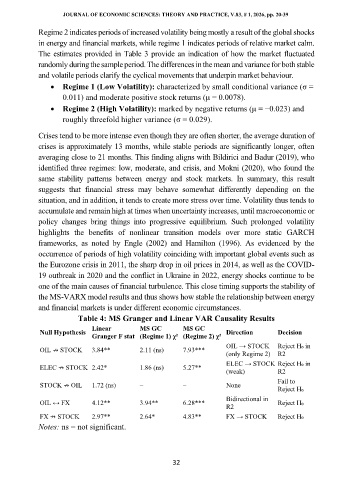
                               Table 4: MS Granger and Linear VAR Causality Results
                                    Linear        MS GC        MS GC
                    Null Hypothesis                                        Direction       Decision
                                    Granger F stat  (Regime 1) χ²  (Regime 2) χ²
                                                                           OIL → STOCK  Reject H₀ in
                    OIL ↛ STOCK     3.84**        2.11 (ns)    7.93***
                                                                           (only Regime 2)  R2
                                                                           ELEC → STOCK Reject H₀ in
                    ELEC ↛ STOCK  2.42*           1.86 (ns)    5.27**
                                                                           (weak)          R2
                                                                                           Fail to
                    STOCK ↛ OIL     1.72 (ns)     –            –           None
                                                                                           Reject H₀
                                                                           Bidirectional in
                    OIL ↔ FX        4.12**        3.94**       6.28***                     Reject H₀
                                                                           R2
                    FX ↛ STOCK      2.97**        2.64*        4.83**      FX → STOCK      Reject H₀
                    Notes: ns = not significant.


                                                           32

